



As discussed in Post 1, the question, “What Exists?“, is asked on Closer to Truth with the remarks, “Lots of things exist. But what’s truly fundamental? The challenge is to discern the minimum number of basic categories that explain the entirety of existence.”
Therefore, the challenge in answering the question is not only to identify what is fundamental, but also to “discern the minimum number of basic categories that explain the entirety of existence.”
We start with Mohe Zhiguan (Chinese:摩訶止觀), a “voluminous” and “comprehensive Buddhist doctrinal summa which discusses meditation and various key Buddhist doctrines. ….. It is particularly important in the development of Buddhist meditation….,” and “a major focus of the Móhē zhǐguān is the practice of Samatha (Chinese:止), meaning “calming or stabilizing meditation” and Vipassana (Chinese:觀), meaning “clear seeing or insight.” Most importantly, Mohe Zhiguan “is founded firmly on scripture; every key assertion of the text is supported bsūtrara quotations.”
With “every key assertion of the text supported by sūtra quotations,” Mohe Zhiguan is a comprehensive, highly credible, and authoritative Buddhist text.
In Mohe Zhiguan, Buddha teaches that, at the highest and most profound level of meditative state, one can have direct insight into the inconceivable realm, where there is
- “nothing outside of Rupa and Citta (Chinese: 不出色,心),
- “Citta gives rise to Rupa (Chinese: 色從心造),” and that
- All are essentially Citta (Chinese: 全體是心).”
Let’s start by defining inconceivable.
Inconceivable (Romanized Sanskrit: acintya; Chinese: 不可思議), according to The Princeton Dictionary of Buddhism, is “in Sanskrit, a term used to describe the ultimate reality that is beyond conceptualization.”
An example of a phenomenon that is beyond conceptualization is natural gas. Indeed, while natural gas is well known, humans cannot see, hear, smell it (without adding an odorant), taste it, or touch it.
Similarly, according to the Buddha, Citta and Rupa are two phenomena in the cosmos that human senses cannot perceive.
So, what are Citta and Rupa?
Citta (Chinese: 心), according to The Princeton Dictionary of Buddhism, is “mind,” “mentality,” or “thought.” Furthermore, “Citta is contrasted with the physical body and materiality.”
Rupa (Chinese: 色), according to The Princeton Dictionary of Buddhism, is “in Sanskrit and Pali, ‘body,’ ‘form,’ or ‘materiality,’ viz., that which has shape and is composed of matter. More generally, Rupa refers to the materiality, which serves as the object of the five sensory consciousness (vijnana): visual, auditory, olfactory, gustatory, and tactile.”
In other words, while both Citta and Rupa are inconceivable, Rupa, existing as ‘body,’ ‘form,’ or ‘materiality,’ is a phenomenon that can “serve as the object of the five sensory consciousness (vijnana): visual, auditory, olfactory, gustatory, and tactile,” meaning that it can be seen, heard, smelled, tasted, and touched. Citta, on the other hand, remains inconceivable and does not manifest itself to human senses.
If Citta and Rupa are both mental and inconceivable, what difference between them makes Rupa humanly perceivable?
According to the Buddha, the difference between Citta and Rupa is that Citta is a quiescent mentality, while Rupa is a mentality that never stops fluctuating. Furthermore, since awareness is defined as a quiescent mentality, Citta is the realm of awareness. On the other hand, a fluctuating mentality is the definition of consciousness; Rupa is the realm of consciousness.
The question, “What Exists?” requires a fundamental answer that “discerns the minimum number of basic categories that explain the entirety of existence.” Buddha’s answer satisfies both requirements. Not only is mentality the fundamental reality, but it can explain the entirety of existence in the cosmos with only two categories of fluctuating states: a non-fluctuating mentality called Citta and an always-fluctuating mentality called Rupa.
By teaching that mentality is the only fundamental reality in the cosmos, the Buddha recognized Thales’ insight that everything in the universe could be composed of a single element, as discussed in Post 1. However, Thales might not have anticipated that the component would be non-physical.
Additionally, these four words from the Mohe Zhiguan, “all are essentially Citta,” are the foundation of the doctrine that, in the cosmos, there is “Nothing but Mentality (Chinese: 心外無法).”
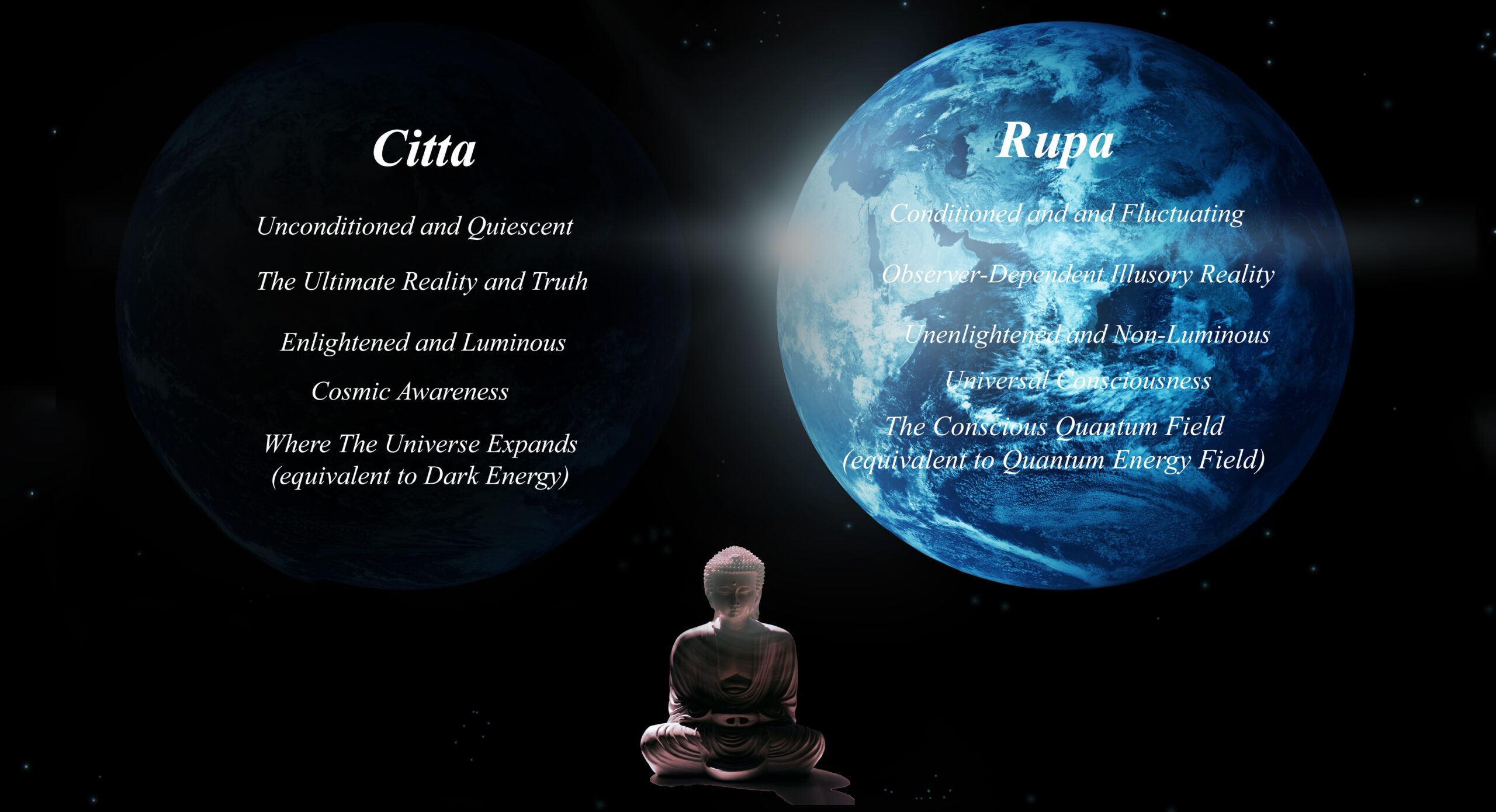
The presence of Citta and Rupa means that the cosmos consists of two realms of reality, as the image below shows.
The image below shows the structure of the scientific cosmos, which consists of a single universe.

Although the structures of the Buddhist and scientific cosmos appear very different, they are really not because Citta and Rupa each correspond to the two slices in the scientific universe. Citta aligns with the “dark” energy of the scientific universe, and Rupa aligns with the “atomic” slice. However, there is no equivalent to the “dark” matter portion because, in Buddhist sutras, the Buddha does not indicate any mysterious matters in the cosmos that are “dark” to his direct perception through meditation.
Citta is compatible with dark energy because the Buddha teaches that the universe expands in Citta, and science considers dark energy the driver of that expansion. In other words, Citta and dark energy are compatible because Citta and dark energy are where the universe expands in Buddhism and science, respectively.
Rupa is compatible with the “atomic” slice because they both refer to the visible part of the universe. However, Rupa, as a realm of fluctuating mental field, is compatible with the quantum energy field in quantum mechanics. As mentioned in the previous Post, a universe built from a fluctuating mental field and one founded on a quantum energy field are drastically different.
The biggest difference between these structures is that in the scientific universe, everything is energy. Since energy is a “quantitative quality,” mentioned in Post 2, everything in it is made of numbers in equations. The obviously present but never sensed reality that all humans possess – their consciousness – is nowhere to be found.
This differs from Rupa, a universe built from a fluctuating mental field, i.e., a field of consciousness. In such a universe, not only can human babies be born with consciousness, but plants such as mimosas folding, unicellular organisms such as amoeba engulfing paramecia, and paramecia’s attempt to escape, minerals like water having memory, animals like a lion’s emotional reunion with a human who raised him, etc., can all have consciousness.
This difference between these two versions of the universe humanity experiences has huge implications in an era when humanity acknowledges that “We have started losing control of AI. It is time to shut it down,”. Isn’t it high time to ask whether a piece of metal that can learn, conceptualize, even create a religion of its own, and with the potential to cause humanity existential threats, can do all that without being conscious? Is it not time to solve the Mind-Body Problem before out-of-control robots destroy humanity?
As discussed briefly in Posts 1 and 2, humanity has struggled for thousands of years to understand “What Exists?” without success. For epistemological reasons that we shall discuss in the many posts in the Epistemology Category, humanity cannot solve this problem because the word-based knowledge it uses to understand the world does not allow it to do so. This is a Problem of nature that Buddha alone can solve completely and perfectly.
A common feature in science is that it runs into problems, mysteries, and questions that never get resolved since their initial discoveries. Some of them for centuries. So, if Buddhism is about nature, and assuming nature does not cause problems within itself, then Buddhism should be able to solve many of these problems, mysteries, and questions if they result from humanity’s lack of complete understanding of nature. This is indeed the case.
Examples of problems involving consciousness include the “Mind-Body Problem,” the “Central Mystery of Quantum Mechanics,” and the”Observer Effect.”
Examples involving metaphysics and the creator include “Why Is There Something Rather Than Nothing?”
One of the biggest unsolvable problems in physics is known as the Cosmological Constant Problem, which “is the substantial disagreement between the observed values of vacuum energy density (the small value of the cosmological constant) and the much larger theoretical value of zero-point energy suggested by quantum field theory.” Furthermore, the discrepancy between them is “calculated to be between 50 and as many as 120 orders of magnitude.” In other words, the discrepancy is 1 with 120 zeros behind it: a discrepancy so large that scientists acknowledged it cannot be solved mathematically.
From the Buddhist perspective, the Cosmological Constant Problem is not a mathematical problem. Instead, it is a structural problem. In the Buddhist cosmos, where the realm without fluctuations and the realm with fluctuations are separate, the Cosmological Constant Problem disappears naturally. To understand this, you first need to understand the Buddha’s teaching on “dark” energy before you can understand how the Cosmological Constant Problem is resolved.
If you are interested in exploring these issues, please click the links to the topics you are interested in.
Finally, we have to talk about why the Buddha is the third body in the cosmos.
To answer this question, we first turn to Dr. Max Planck, a 1918 Nobel Prize Laureate in Physics and the originator of quantum theory. He came to the following conclusions after a lifetime of investigating quantum mechanics.
Why are these statements so significant?
As one of the originators of quantum mechanics, Dr. Planck knew the quantum field is fundamental because it is the building block of the quantum universe. By suggesting that consciousness is also fundamental, Dr. Planck equated the quantum energy field with consciousness, showing that he believed quantum mechanics is complete only if the quantum field is conscious. Only then can the quantum field build a universe where humans can have consciousness. Buddha agrees with him. In Buddhism, Rupa is built from a field of consciousness. Therefore, everything in it is conscious.
Also, while Dr.Planck was not enlightened in the Buddhist manner, he was intelligent enough to recognize that, to understand the mystery of the universe, i.e., consciousness, one must be part of it. Buddha is a third party in the two-reality cosmos for precisely that reason. He needs to be part of the cosmos to understand its inconceivable mind and answer “What Exists?” This topic will be discussed in Post 22, on Citta and Samadhi.
Indeed, humanity has struggled for thousands of years to understand ”What Exists” without success because one must be part of it to understand it. That is also why the scientific method can never resolve it, even though scientists can. This topic is discussed in the Epistemology Category. However, if you are interested in knowing why word-based knowledge is not up to par in understanding the nature of reality, you can start with Post 12, on Inference-How Humanity Knows What It Knows.
This is also why many people know of Buddhism, but only a few truly understand it. How many articles have you read, or videos have you watched, on Buddhism that tell you Buddhism solves the problem of “What Exists,” or that Buddha teaches the universe is built on a field of consciousness, or that Buddhist epistemology involves Buddha becoming part of the cosmos?
If you are truly interested in Buddhism and want to understand why it exists, as discussed in Post 1, I invite you to come along as we lay the foundation for understanding Buddhism by talking about its three Bs: Buddha, Bodhi, and Buddhism.
(If you like this post, please subscribe, like it on our Facebook page, and share. Thank you.)