



In Post 1, we introduced the question “What Exists?” and noted that even with the advent of Einstein’s Theories of Relativity and quantum mechanics, humanity still struggles with this mystery. In this post, we discuss how humanity has struggled to understand it since the pre-Socratic Greek philosophers.
One of these pre-Socratic Greek philosophers was Thales of Miletus, one of ancient Greece’s seven sages and a founding figure who accurately predicted a solar eclipse in 585 BC. According to Bryan Magee, author of The Story of Philosophy, “The question that most obsessed Thales was, ‘What is the world made of? It seemed to him that it must ultimately be made from a single element.” While he mistakenly assumed that the single element was water, Magee suggests that his insight was “amazing because the physics that led up to it had not yet been done.”
Pythagoras of Samos, a polymath well known for his eponymous Theorem, was another pre-Socratic ancient Greek philosopher who, according to Bryan Magee, “was the first person to have the idea that all the workings of the material universe are expressible in terms of mathematics.”
The two pre-Socratic Greek philosophers are mentioned because their ideas remain relevant today.
Since ancient Greece, humanity has depended on observation to investigate reality. However, understanding reality based on observation has never been reliable and is often subject to change.
Euclid was an ancient Greek mathematician and was considered the “father of geometry.” His geometry is called “planar geometry” because he thought the Earth was flat based on his observations. Later, when scientists found that the Earth is spherical, they expanded Euclid’s planar geometry to non-Euclidean geometry, which significantly helped navigation around the globe.
In the Middle Ages, geocentrism, the idea that the Earth was at the center of the universe, with the Sun, moon, stars, and planets revolving around it, was the predominant view regarding the shape of the universe. However, in the sixteenth century, Nicolaus Copernicus, a Renaissance astronomer and Catholic cleric, challenged the idea and proposed a mathematical model of heliocentrism, suggesting that the Earth orbits the Sun. Galileo Galilei then provided supporting evidence by observing the sky with a telescope.
Isaac Newton was the first scientist to propose that reality exists as solid particles. However, he never investigated whether solid particles actually existed. According to author Fritjof Capra of The Tao of Physics, Newton wrote the following in his Opticks, “It seems probable to me that God in the beginning formed matter in solid, massy, hard, impenetrable, movable particles, of such sizes and figures, and with such other properties, and in such proportion to space, as most conduced to the end for which he formed them; and that these primitive particles being solids, are incomparably harder than any porous bodies compounded of them; even so very hard, as never to wear or break in pieces; no ordinary power being able to divide what God himself made one in the first creation.” The author added, “In the Newtonian view, God had created, in the beginning, the material particles, the forces between them, and the fundamental laws of motion.”
While Newton’s mathematical theory worked exceptionally well for hundreds of years and still is used, the solid particles he believed God created no longer exist in light of quantum mechanics. Quantum scientists, such as Dr. David Tong of the University of Cambridge, came to realize not only that “there are no particles in the world” but also that quantum fields have become the building blocks of the universe.
This, of course, represents a seismic change in humanity’s understanding of reality. From the Buddhist perspective, however, it is a giant step closer to the nature of reality.
In this video, How is the Cosmos Constructed, 2004 Nobel Laureate Dr. Frank Wilczek added more details: “The most basic objects out of which to construct the universe are not particles but objects we call quantum fields. We think of them as space-filling ethers that create and destroy the objects, the particles. …….. We see particles as epiphenomena. They are kind of ripples on the deep structure.” While Dr. Wilczek did not elaborate on the “deep structure,” we know the ripples he referred to are the ripples of the quantum fields he mentioned.
So, what is quantum energy?
Quantum, as defined, “is a discrete quantity of energy proportional in magnitude to the frequency of the radiation it represents.”
Energy, on the other hand, is, “in physics,” a “quantitative property that is transferred to a body or a physical system, recognizable in the performance of work and in the form of heat and light.”
Together, it means that all phenomena in a universe built from a quantum energy field are made of “discrete quantities of quantitative properties.” Put simply, everything in the quantum mechanical universe, including humanity, is made of numbers in equations.
However, while numbers in equations can help scientists understand how one phenomenon relates to another and satisfy Pythagoras’ insight “that all the workings of the material universe are expressible in terms of mathematics,” they say nothing about what exists in nature. Most significantly, in such a universe, an obviously present but never seen reality that all humans possess- consciousness- is nowhere to be found.
This is not to denigrate quantum mechanics, far from it. In fact, if any contemporary scientific theory complements Buddhism most, it is quantum mechanics, especially quantum field theory.
To many of its supporters, quantum field theory is “The Most Beautiful Theory in Physics.” Additionally, in this discussion on “What Exists?”, Dr. Sean Carroll of Johns Hopkins University boldly stated that “the universe is a quantum mechanical wave function.” In other words, in Dr. Sean’s opinion, the quantum mechanical wave function can explain all existence in the universe.
While Buddha would mostly agree, he would say that Dr. Sean’s statement would be complete only if the quantum mechanical wave function were conscious. This is what Buddhism offers: a quantum mechanical universe of consciousness, not energy.
Indeed, Buddha agrees with quantum mechanics that the universe is founded on a fluctuating field. However, what fluctuates in the Buddhist field is not energy, but mentality. As discussed in the last post, a fluctuating mentality is the definition of consciousness, while awareness is a quiescent mentality, as Adyashanti verified. In other words, the Buddhist universe is founded in a field of consciousness. Such a universe is also a quantum universe because conscious thoughts also come in and out of existence in discretely small amounts.
Therefore, in the Buddhist universe, not only can human babies be born with consciousness, but plants such as mimosas folding, unicellular organisms such as amoeba engulfing paramecia, and paramecia’s attempt to escape, minerals like water having memory, animals like a lion’s emotional reunion with a human who raised him, etc., can all have consciousness.
The beauty of quantum field theory agreeing with Buddhism is that it makes it possible to use a phenomenon scientists consider energy to help understand the same phenomenon Buddha considers conscious. Epiphenomenon is a good example. Indeed, we will discuss not only epiphenomena in Buddhism, but also Buddha’s teaching on a Higgs boson equivalent and many others listed in the Standard Model.

The image above, created by Dr. David Tong, shows ripples in a quantum field. These are the tiniest epiphenomena in the quantum universe.

The image above, courtesy of Dr. Tony Tyson of UC Davis, is shown in Dr. Lawrence Krauss’s lecture on “A Universe From Nothing.” According to Dr. Krauss, “The spikes are where the galaxies are.” However, the image does not show galaxies as individual entities. Instead, it shows them as huge ripples in a field that connects them all. In other words, galaxies also exist as epiphenomena.
Ripples in a fluctuating field are called epiphenomena (Chinese: 伴隨現像) because they are secondary phenomena arising from the primary phenomenon, which is the quantum energy field. As epiphenomena, ripples exist only when the quantum energy field fluctuates. If the quantum energy field ever stops fluctuating, epiphenomena also cease to exist.
To understand how epiphenomena can explain this phenomenon, one needs to understand that an epiphenomenon of energy and an epiphenomenon represent two different things.
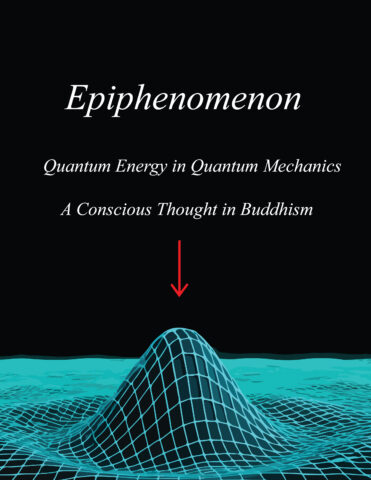
As discussed, in quantum mechanics, an epiphenomenon in quantum energy represents a discrete amount of a quantitative property. However, in Buddhism, an epiphenomenon is a ripple in consciousness. Therefore, it represents a conscious thought.
So, when the mind becomes quiescent upon enlightenment, all epiphenomena in the mind cease to exist and, therefore, the universe disappears, as Adyashanti discussed in the last post.
To understand why, one needs to understand Buddha’s answer to “What Exists?,” which we will discuss in greater detail in the next post. There, you will discover a cosmos similar to the human mind because it also consists of two realms of reality, one enlightened and one unenlightened. What reality one experiences depends on which realm one’s mind is in. As Adyashanti showed, an enlightened mind resides in the enlightened realm where he is aware that the universe does not exist. The universe does not exist because the realm of enlightenment is quiescent and without epiphenomena. However, when he wakes up from his enlightened state, he is conscious that there is a universe, just like all of us who are unenlightened.
Indeed, in a universe where there is Nothing but Mentality, everything that exists exists in the mind.
(If you like this post, please subscribe, like it on our Facebook page, and share. Thank you.)