
What Exists?: Nothing but Mentality
What Is Buddhism?
Many people are familiar with Buddhism, but few truly understand it. Supported by Buddhist dictionaries, epistemology, and quantum field theory, a theretofore never-used combination to understand Buddhism, this website argues that Buddhism is not a religion, philosophy, psychology, or science, even though they are complementary. Instead, it argues that Buddhism is a unique teaching from our historical Shakyamuni Buddha about the nature of the reality humans experience. Furthermore, it argues Buddhism’s uniqueness lies in the fact that Buddha solves a problem humanity has struggled to understand for thousands of years without success: the question of “What Exist?” by expanding the scope of epistemology to include direct perception.
What Exists? The Question.
The question, What Exists?, is asked on Closer To Truth with the remarks, “Lots of things exist. But what’s truly fundamental? The challenge is to discern the minimum number of basic categories that explain the entirety of existence.”
What Exists? Humanity’s Struggle to Understand
Asking the question “What Exist?” even in the light of Relativity and quantum mechanics reflects a significant deficiency in human knowledge: what constitutes the world in which humanity lives? It is, in fact, a question that humanity has struggled to understand since pre-Socratic philosophers to the present day. For a simplified discussion of humanity’s struggle to understand reality without success, please click here.
“What Exists?” Buddha Answers.
According to Buddha, mentality is the only perduring reality in the cosmos. Furthermore, mentality exists in two distinct states of fluctuations: quiescent and fluctuating. These two states of fluctuating mentality explain the entirety of existence in the cosmos.
The question, What Exists? demands a simple answer. Not only did Buddha offer a fundamental, simple answer, but also with the minimum number of categories: two.
What Makes Buddhism Unique?
The uniqueness of Buddhism is that Buddha teaches that two means of knowledge are necessary to understand the two realities manifested by the two states of fluctuating mentality.
While inference refers to inferentially connected, word-based knowledge that humanity uses typically to understand the perceivable universe, direct perception is another means by which humanity can comprehend the inconceivable world of mentality by becoming part of it, as Dr. Max Planck understood.
Dr. Max Planck was a 1918 Nobel Prize Laureate in Physics and the originator of quantum theory. After a lifetime of studying quantum mechanics, he understood the limits of science, as he said:
Two Different Structures of the Cosmos.
Since the scientific method relies on inference, and Buddhism relies on direct perception, their respective understandings of cosmology differ markedly.
The Cosmos According To NASA

By relying exclusively on inference, the scientific cosmos consists of a single universe in which everything is energy and human consciousness is absent. Furthermore, 95.4% of the universe remains “dark”, and whether particles exist in the remaining 4.6% is debated. Moreover, it is a universe full of unsolved questions, problems, and mysteries, such as “What Exist?” “Is Consciousness Ultimate Reality?” the “Cosmological Constant Problem,” the “Mind-Body Problem,” the “Central Mystery of Quantum Mechanics,” and “Why Is There Something Rather Than Nothing?” At the same time, humanity cannot have its consciousness.
To understand the scope and limits of science, it is essential first to comprehend the limits of How Humans Know What They Know.
The Cosmos According to Buddha
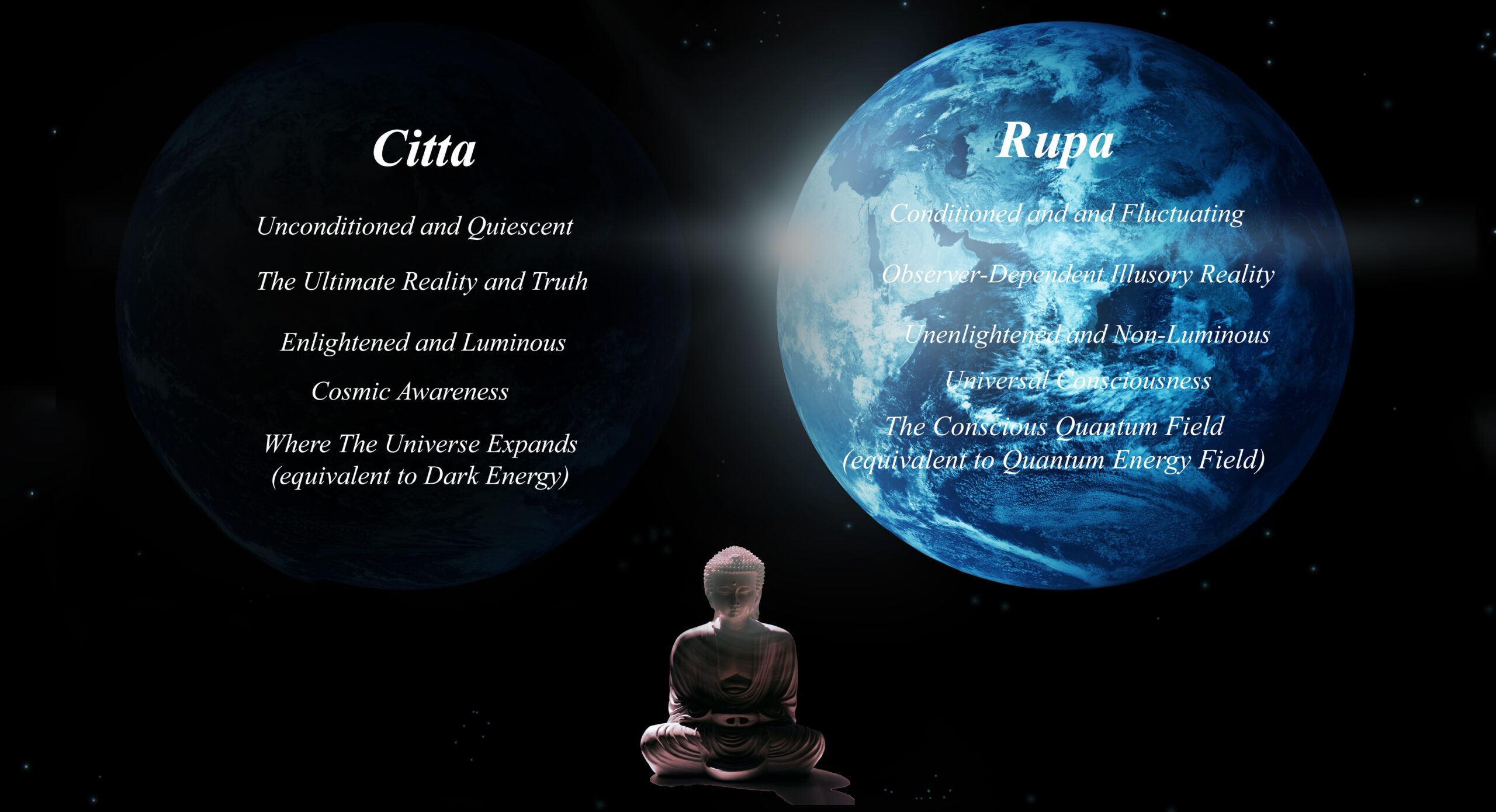
Buddha teaches that the cosmos is a Three-Body Structure. Citta, the realm of the quiescent mentality, is the Ultimate Reality and Truth. It corresponds to the Dark Energy slice of the NASA universe, where the cosmos expands. The realm of the fluctuating mentality is known as non-luminosity. It corresponds to the quantum energy field in the NASA universe, except that it is conscious.
The benefit of having two realms of mentality, separated by fluctuating statuses, is that it addresses many problems and mysteries in the NASA universe that have remained unsolved since their discovery, such as the “Cosmological Constant Problem.” Not only is “Dark Energy” identified as the Ultimate Reality, but the quantum energy field is complete by having consciousness. The Mind-Body Problem is gone; “The Central Mystery of Quantum Mechanics” and the Observer Effect are explained; and “Why Is There Something Rather Than Nothing?” is answered.
The Buddha is part of the three-body structure, alongside the two realms of reality corresponding to quiescent and fluctuating mentality, as explained earlier.
The Five Aggregates: An Observer-Dependent Universe.
The quantum mechanical theory postulates that “reality at its fundamental level is uncertain, fluid, and dependent on observation.” Buddha agrees. The Five Aggregates are his teaching on why the universe is illusional. Read Post 27 to understand why the existence of the universe depends on your observation, and why it happens without your knowing or control.
The Question For the AI Era: What If Machines that Learn are Conscious?
In this era of AI, understanding “things as they are” is no longer about living longer; failing to understand “things as they are” may actually pose an existential threat to humanity as a whole.
In a span of only two years, when AI leaders started calling for regulations “to prevent AI (from) destroying humanity” to acknowledging that “artificial general intelligence (AGI) could lead to human extinction or an irreversible global catastrophe,” is it not high time for humanity to know that machines that can learn are conscious?
To read the discussion on this topic, please go to Post 34.
Why Buddhism Exists?
Do you know that your lack of knowledge about “What Exist” can actually hurt you? Do you know why you should learn Buddhism? Do you know what everlasting benefits await you when you understand “What Exist?” This topic is discussed in Post 35.
(This website is being updated. Your patience is appreciated as new information is added and the content is rearranged to facilitate understanding of Buddhism. Please check back regularly to see new content. Or you can subscribe so notifications will be sent to you when updates are posted.)

25. Epistemology (v) Direct Perception – The Path To Enlightenment
After discussing inference, the Buddha’s first means of knowledge in an earlier post, this post explores direct perception, the Buddha’s second means of knowledge, and…

24. Epistemology (iv) The Kalama Sutta
Having discussed the inferentially connected nature of word-based knowledge in the previous post, we discussed the Kālāma Sutta in this post. The Kālāma Sutta is…

23.Epistemology (iii) – Inference-How Do We Know What We Know?
As this Wikipedia article states, “Epistemology is the branch of philosophy that examines the nature, origin, and limits of knowledge. Also called the theory of knowledge, it…

22. Epistemology (ii) – A Mind-Body Problem?
The discussion on epistemology begins with the so-called Mind-Body Problem. The Mind-Body Problem is a Problem that “has been a central issue in philosophy of mind since…

21. Epistemology (i) Buddha and the Monkey King
Among the heroes of Chinese mythology, the Monkey King holds a prominent position. Monkey King originated from the novel Journey to the West, in which…

20. The Two Realms (iii) Verifying Adventitiousness
In this post, we try to verify the adventitious relationship between enlightenment and unenlightenment. But let’s first recall the meaning of enlightenment, unenlightenment, and adventitiousness…

19. The Two Realms (ii) – The Four Realms of Reality
In this post, we discuss the Four Realms of Reality, a Buddhist doctrine in which the Buddha teaches that there are four ways of understanding…

18. The Two Realms (i) – Where There Is No Cosmological Constant Problem
In this post, we discuss the Cosmological Constant Problem and why it cannot exist in the cosmos Buddha teaches. To understand the Cosmological Constant Problem,…

17. Non-Luminosity (vi) Namarupa
In this post, we discuss namarupa, a term Buddha uses to indicate that all Rupa are Rupa in name only. As discussed in Post 4,…

16. Non-Luminosity (v) Higgs Equivalent and Beyond
After discussing how Buddhism and quantum mechanics meet in epiphenomena, we explore Buddhism’s complete list of “dusts” and compare it with how science arranges its…