5. Such Is The Way Of Dharma-A Three-Body Cosmos

In this post, we discuss the Buddhist doctrine known as “Such is the Way of Dharma (Chinese: 法爾如是).”

The doctrine “Such Is The Way of Dharma” comes from Śūraṅgama Sūtra (Chinese: 首楞嚴經), which is “a Mahāyāna Buddhist sūtra that has been especially influential on Korean Buddhism (where it remains a major subject of study in Sŏn monasteries) and Chinese Buddhism (where it was a regular part of daily liturgy during the Song). It was particularly important for Zen/Chan Buddhism. The doctrinal outlook of the Śūraṅgama Sūtra is that of Buddha-nature, Yogacara thought, and esoteric Buddhism.”

In the Śūraṅgama Sūtra, Buddha defines “Such is the Way of Dharma” as Noncausal, not natural. Such is the Way of Dharma (Chinese: 非因緣,非自然,法爾如是.”

Suchness is known in Romanized Sanskrit as tathata.

Tathata (Chinese=真如), according to the Princeton Dictionary of Buddhism, is “in Sanskrit, ‘suchness,’ or ‘thusness,’ a term for ultimate reality, especially in Mahāyāna schools. Along with terms such as “Dharmata, Dharmadhatu, and Bhutakoti …..referring to the eternal nature of reality that is ‘ever thus,’ or ‘just so,’ and free of all conceptual elaborations.” In Yogacara/Vijnanavada, the term refers to the ultimate wisdom that is free from the subject-object distinction (grahyagrahakavikalpa).” “In the Madhyamaka school, any attempt to substantiate the nature of reality is rejected, and tathata is instead identified with emptiness and the cessation of all dichotomizing tendencies of thought.”

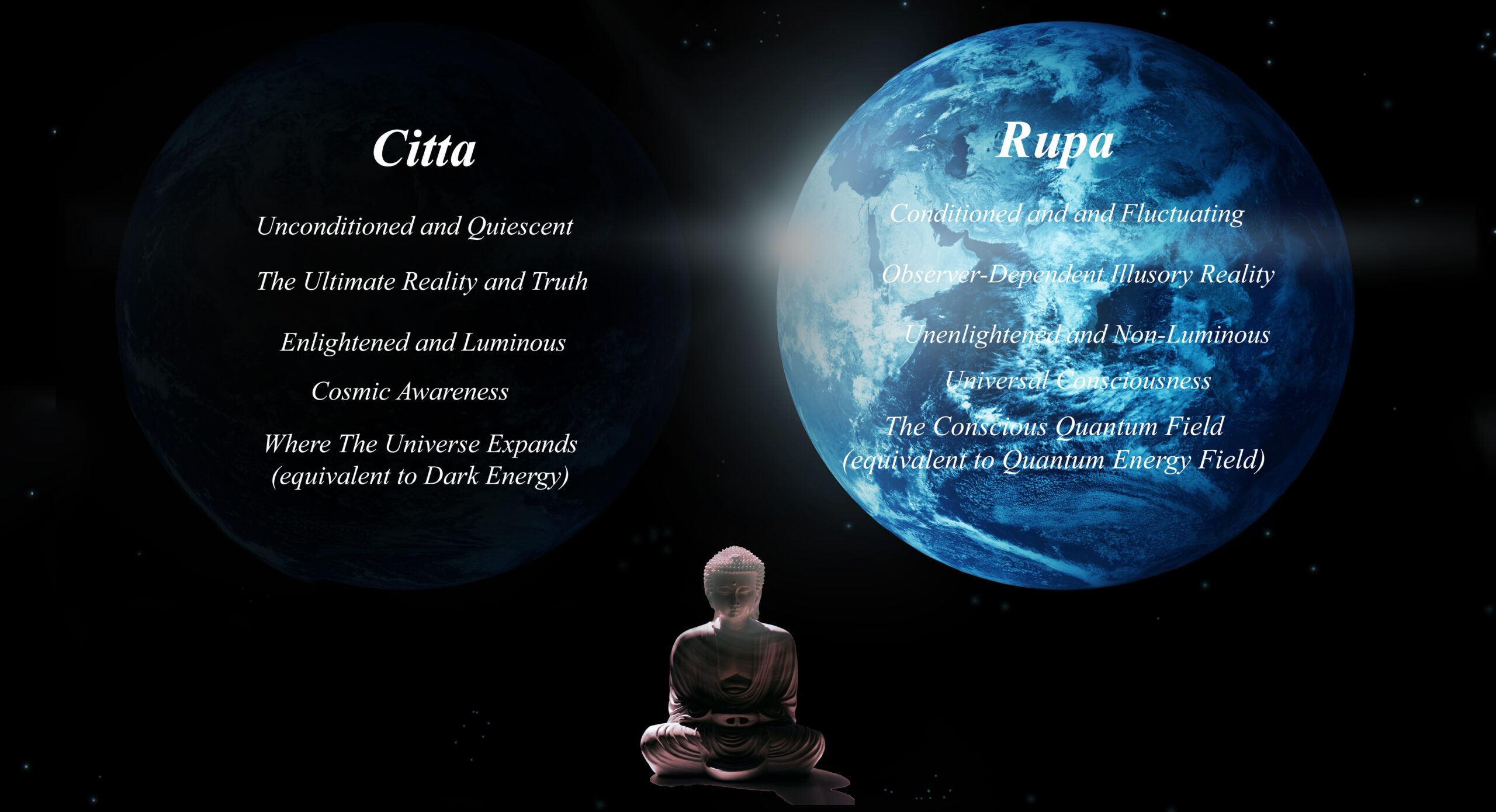
From the definition of Suchness, we know that citta and rupa are “eternal.” Furthermore, as discussed in the previous post, according to Buddha, the cosmos consists of an unconditioned with and a conditioned realm of citta and rupa, both of which are mentality. Additionally, Buddha describes mentality as inconceivable, meaning it is imperceivable, i.e., it cannot be seen, heard, smelled, tasted, or touched. Since imperceivable phenomena are necessarily ineffable, Suchness means that Buddha can only describe the eternal and inconceivable nature of citta and rupa as “ever thus” or “just so,” or Suchness.

As the late CBS anchorman Walter Cronkite used to say after his broadcast every evening, “And that’s the way it is.” Suchness is Buddha’s way of relaying the same: the world of mentality is so inconceivable that the best way to describe it is “ever thus. or “just so.”  

Let’s discuss the meaning of “noncausal” and “not natural” in Noncausal, not natural. Such is the Way of Dharma (Chinese: 非因緣,非自然,法爾如是.”

A) Noncausal

  • Given that citta and rupa are eternal, nothing could have caused their existence, or they could not be eternal.
  • So, does that also mean there is no causal relationship between these two realms?
  • Indeed, that is the case. In Aṅguttara Nikāya (Chinese: 增一阿含經), “a Buddhist scriptures collection, the fourth of the five Nikāyas, or collections, in the Sutta Pitaka, which is one of the ‘three baskets’ that comprise the Pali Tipitaka of Theravada Buddhism,” Buddha teaches that there is an adventitious relationship between citta and rupa.  
  • By the definition of adventitiousness (Chinese: 偶然, 不定), Citta and non-luminosity are “associated by chance rather than as an integral part.
  • In Buddhism, if two phenomena are associated by chance, it necessarily means there is no causal relationship between them.
  • Being adventitious, citta and rupa are “extrinsic,” meaning that they are not integral.
  • Therefore, according to Buddha, the cosmos consists of two bodies. In other words, unlike human and scientific understanding, the universe humans experience is not the only body in the cosmos.

B) Not Natural

As discussed when discussing A Few Fundamental Concepts, mentality is the mystery humanity has struggled to understand since pre-Socratic Greek philosophers, without success. Furthermore, as the 1918 Nobel Laureate in Physics, Dr. Max Planck understood, understanding the mystery of mentality requires being part of it. This is what Buddha did as he meditated under the Bodhi Tree until his enlightenment. Enlightenment enabled Buddha to perceive the world of mentality directly. Direct perception enabled Buddha and other similarly enlightened individuals to become part of the world of mentality and comprehend it.

Until enlightened, a nature of reality that is eternal and consists of Nothing but Mentality, along with concepts such as “free from the subject-object distinction (grahyagrahakavikalpa),” “free of all conceptual elaborations,” the cessation of all dichotomizing tendencies of thought,” will continue to be “not natural” for the vast majority of the unenlightened individuals.

Because the Buddha needs to be part of the cosmos to learn its knowledge, Buddha, alongside the two realms of citta and rupa, must be part of the cosmos he investigates. For this reason, the mental cosmos is a three-body structure.


Leave a comment