
If you look out the window, see a beautiful world, and deem it real, you should know that Einstein allegedly said that “Reality is merely an illusion, although a very persistent one.” Additionally, do you know that quantum mechanics agrees and “suggests that reality at its fundamental level is uncertain, fluid, and dependent on observation.” Furthermore, smart people like Elon Musk are interested in the Simulation Theory or Simulation Hypothesis, which “suggests that everything we experience in life could be a mere projection of a sophisticated computer program.” Also, others opine that the World is a Hologram because “the combination of quantum mechanics and gravity requires the three-dimensional world to be an image of data that can be stored on a two dimensional projection much like a holographic image.”
If you wonder why so many smart people and even most advanced contemporary scientific theories have doubts about the world humans experience, it is because humanity and even contemporary scientific theories lack an understanding of “What Exists?”
The question, “What Exists?“, is asked on Closer To Truth with the remarks, “Lots of things exist. But what’s truly fundamental? The challenge is to discern the minimum number of basic categories that explain the entirety of existence.”
In an episode on Closer to Truth, four scientists were invited to discuss “What Exists.” Among them, there were four different views, ranging from a quantum physicist who believes that “the universe is a quantum mechanical wave function,” to one believing that consciousness has equal standing with physics, to one who thinks that reality is limited to what is only known to science, to a quantum physicist who believes in God. However, they were unable to express a unanimous opinion on “What Exist?”
Indeed, asking “What Exist?” reflects humanity’s lack of understanding of the reality in which humans live. As discussed in the Overview post, humanity’s struggle to understand the nature of reality began with pre-Socratic Greek philosophers and has continued since then without success.
However, what most people do not know is that Buddha provided the answer more than 2600 years ago while meditating under the Bodhi Tree.
Buddha’s answer is straightforward. There is Nothing but Mentality (Chinese: 心外無法) in the cosmos because mentality is the only perduring reality. Furthermore, mentality falls into two categories of fluctuations: quiescent and fluctuating. These two categories of fluctuations explain “the entirety of existence.”
As the original question demanded, Buddha’s answer is fundamental and consists of the minimum number of categories, two.
The doctrine of Nothing but Mentality is based on Buddha’s teachings in the Mohe Zhiguan.
Mohe Zhiguan (Chinese: 摩訶止觀) is a “voluminous” and “comprehensive Buddhist doctrinal summa which discusses meditation and various key Buddhist doctrines. ….. It is particularly important in the development of Buddhist meditation….,” and “a major focus of the Móhē zhǐguān is the practice of Samatha (止 zhǐ, calming or stabilizing meditation) and Vipassana (觀 guān, clear seeing or insight). Most importantly, Mohe Zhiguan “is founded firmly on scripture; every key assertion of the text is supported by sūtra quotations.”
With “every key assertion of the text supported by sūtra quotations,” Mohe Zhiguan is comprehensive, highly credible, and authoritative.
One doctrine that Mohe Zhiguan teaches is “The Tenth Vehicle for Insights into Principle (Chinese: 十乘之理觀).” The meaning of “principle” and “vehicle” needs to be explained.
To understand the meaning of “principle,” one must first understand the meaning of tattva.
Tattva (Chinese: 實相), according to the Princeton Dictionary of Buddhism, is “in Sanskrit, lit., “thatness,” a term with two important denotations. First, it can mean “ultimate reality,”.. the reality, free from all conceptual elaboration, that must be understood in order to be liberated from rebirth… Second, it may be translated as “principle.“”
Many Buddhist terms refer to the Ultimate Reality, each from a different perspective. “Principle (Chinese: 理)” is one such term for the Ultimate Reality from the standpoint that the Ultimate Reality is “free from all conceptual elaboration.”
“Vehicle (Chinese: 乘), known in Romanized Sanskrit as yana, is, according to The Princeton Dictionary of Buddhism, “a common Sanskrit term for any means of transportation. In Mahāyāna literature, the term takes on great significance in the metaphorized sense of a mode of transportation along the path to enlightenment.” In the current context, “tenth vehicle” refers to the highest and most profound meditative state among the meditative states. It leads to insight into the inconceivable realm (Chinese: 不可思議境).
Inconceivable (Chinese: 不可思議), is known in Romanized Sanskrit as acintya, according to The Princeton Dictionary of Buddhism, is “a term used to describe the ultimate reality that is beyond conceptualization.”
In other words, “inconceivable” and “principle” both refer to the fact that the Ultimate Reality is a reality that is beyond perception, i.e., it cannot be seen, heard, smelled, tasted, or touched. In Chinese Mahāyāna Buddhism, this phenomenon is described as “the mark of the Ultimate Reality is without mark (Chinese: 實相無相).
An example of a reality that cannot be perceived is natural gas. Because natural gas cannot be seen, heard, smelled, tasted, or touched, odorants are added so it can be detected in the event of a leak, helping prevent disaster.
The lecture notes that Dharma Master Jing Kong (Chinese: 淨空法師) uses in this discussion are known as “The Chapter on the Ten Vessels of Insight into Reality in Tripitaka by Numbers, taken from Mohe Zhiguan (Chinese: 三藏法數十乘條: [出摩訶止觀]).”
Tripitaka (Chinese: 三藏), according to The Princeton Dictionary of Buddhism, is “in Sanskrit, ‘three baskets,’ one of the most common and best known of the organization schema of the Indian Buddhist canon. The three baskets were Sutrapitaka (Chinese: 經藏) (basket of discourses), Vinayapitaka (Chinese: 律藏) (basket of disciplinary texts), and Abhidharma Pitaka (Chinese: 論藏) ( [alt. “Sastrapitaka] (basket of “higher dharma” or “treaties.“)
Mohe Zhiguan belongs to the Sutrapitaka basket.
Tripitaka by Numbers (Chinese: 三藏法數) is a well-known Chinese Buddhist encyclopedia that organizes the Buddha’s teachings by numerical categories. For example, the doctrine “The Tenth Vessels of Insight into Reality” would be categorized under ten.
So, what insight can one expect from the inconceivable realm (Chinese: 觀不可思議境)?
First, a rhetorical question:
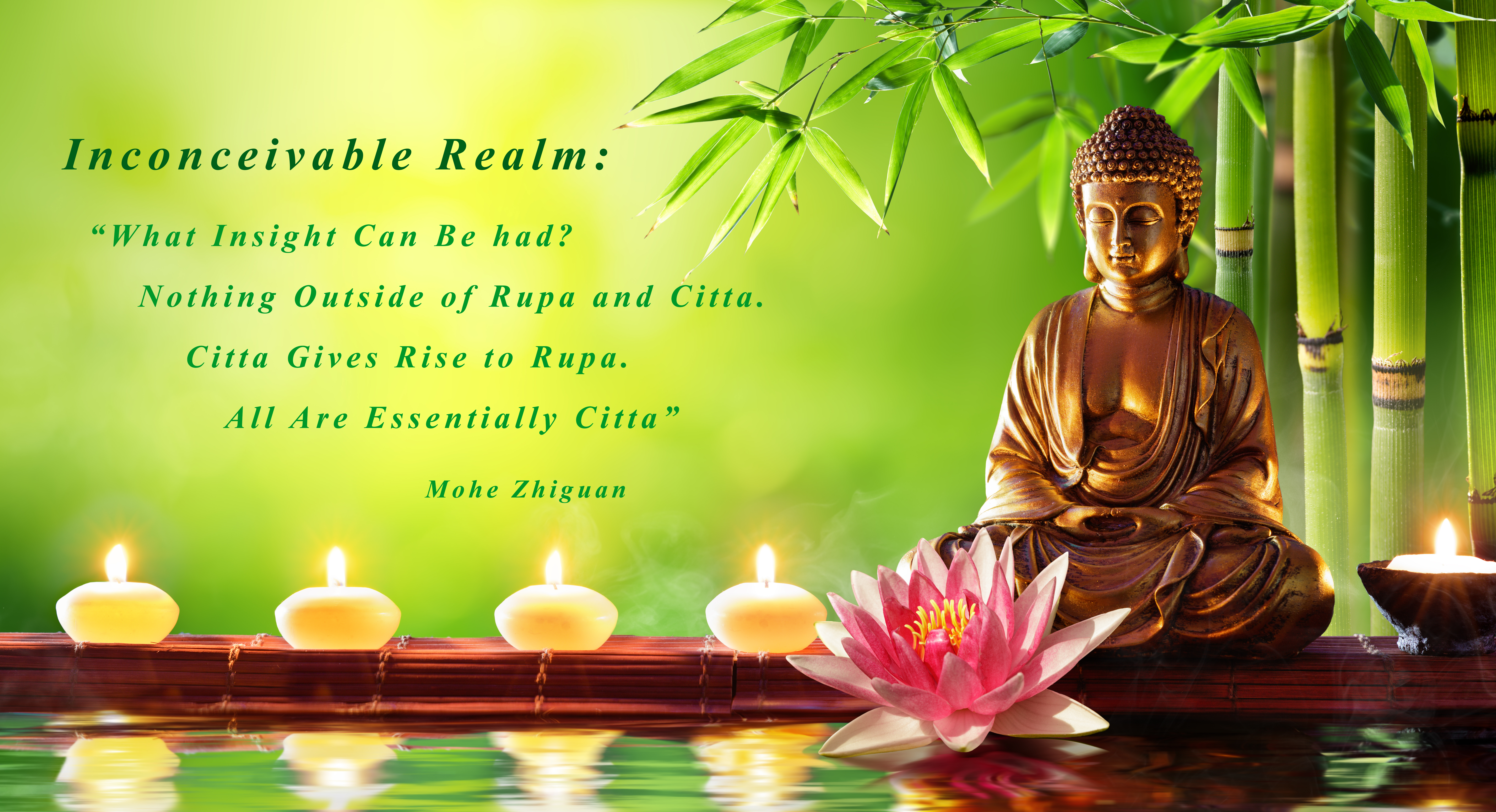
“What insight can be had (Chinese: 所觀者何)?”
The answer:
“Nothing outside of rupa and citta (Chinese:不出色,心).”
“citta gives rise to rupa (Chinese:色從心造).”
“All are essential citta (Chinese: 全體是心).“
Citta (Chinese: 心), according to The Princeton Dictionary of Buddhism, is “mind,” “mentality,” or “thought.” Furthermore, “Citta is contrasted with the physical body and materiality.”
Rupa (Chinese: 色), according to The Princeton Dictionary of Buddhism, is “in Sanskrit and Pali, ‘body,’ ‘form,’ or ‘materiality,’ viz., that which has shape and is composed of matter. More generally, rupa refers to the materiality, which serves as the object of the five sensory consciousness (vijnana): visual, auditory, olfactory, gustatory, and tactile.”
These statements in Mohe Zhiguan make clear that rupa and mentality are the only realities in the cosmos. However, Rupa is also mental because mentality gives rise to it. Therefore, Mohe Zhiguan summarizes, “All are essentially citta.” This four-word summary is the foundation that there is “Nothing but Mentality (Chinese: 心外無法)” in the cosmos.
In Sandhinirmocana Sūtra (Chinese: 解深密經), “a Mahāyāna Buddhist text and the most important sūtra of the Yogācāra school,” Buddha teaches that “there are two types of dharma, one conditioned, and the other unconditioned (Chinese: 一切法者,略有二種,一者有為,二者無為“).
Known as the Two Conditions of Dharma (Chinese: 二為法), it is Buddha’s most fundamental bifurcation scheme for all phenomena in the cosmos.
First, let’s begin by defining the meanings of dharma and condition.
Dharma (Chinese: 法), according to The Princeton Dictionary of Buddhism, is “in Sanskrit, ‘factor,’ or ‘element:’ a polysemous term of wide import in Buddhism and therefore notoriously difficult to translate, a problem acknowledged in traditional sources; as many as ten meanings of the term are found in the literature.” However, “one of its most significant and common usages is to refer to ‘teachings’ or ‘doctrines,’ whether they be Buddhist or non-Buddhist.” “A second (and very different) principal denotation of dharma is a physical or mental “factor” or “fundamental” “constituent element,” or “simply phenomenon.”
When discussing reality, dharma means “simply phenomena“.
Condition (Romanized Sanskrit: pratyaya; Chinese: 緣), according to The Princeton Dictionary of Buddhism, refers “to the subsidiary factors whose concomitance results in the production of an effect from a cause.” “For example, in the production of a sprout from a seed, the seed would be the cause (Hetu), while such factors as heat and moisture would be conditions (pratyaya).”
A) Conditioned Dharma (Sanskrit: samskrtadharma; Chinese: 有為法), according to The Princeton Dictionary of Buddhism, is “a term that describes all impermanent phenomena, that is, ‘all phenomena that are produced through the concomitance of causes and conditions.'” Furthermore, “Buddha is said to have taught: When this is present, that comes to be, / From the arising of this, that arises. / When this is absent, that does not come to be. / From the cessation of this, that ceases.”
B) Unconditioned Dharma (Romanized Sanskrit = asamskrtadharma; (Chinese: 無為法), according to The Princeton Dictionary of Buddhism, “is “in Sanskrit, (also called) “uncompounded,”…. not conditioned and therefore perduring phenomena that are not subject to impermanence.”
In other words, between citta and rupa, one is unconditioned while the other is conditioned. We will discuss which is which in a future post. In the next post, we will discuss Buddha’s doctrine known as Such is the Way of Dharma, another fundamental doctrine on citta and rupa.
(If you like this post, please like it on our Facebook page and share. Thank you.)