

This post discusses Buddha’s doctrine of the Five Aggregates. The significance of the Five Aggregates Doctrine in Buddhism is hard to overstate.
- Understanding the Five Aggregates answers a question that even an enlightened individual cannot answer: why does the universe disappear upon enlightenment? Why is it not the other way around?
- Understanding the Five Aggregates enables an advanced Bodhisattva to “perfect his understanding of emptiness,” overcome his cognitive obstructions, and satisfy the Buddha’s soteriological mission by becoming a Tathagata. In the next post, we will discuss such a case involving Bodhisattva Avalokiteśvara, as mentioned in the Heart Sūtra.
- As mentioned in Post 1, quantum mechanics holds that “reality at its fundamental level is uncertain, fluid, and dependent on observation.” Buddha agrees and, in the Five Aggregates, he explains why and how reality is observer-dependent.
The Five Aggregates Doctrine is also helpful to science because it helps explain the Observer Effect, also known as the central mystery of Quantum Mechanics. The Five Aggregates Doctrine also addresses a centuries-old unresolved question: “Why Is There Something Rather Than Nothing?”
Aggregates are known in Romanized Sanskrit as skandha.
Skandha (Chinese: 蘊), according to The Princeton Dictionary of Buddhism, is “in Sanskrit, lit. ‘heap,’ viz. ‘aggregates,’ or ‘aggregates of being.'”
While the Five Aggregates are critically important in Buddhism, they are also poorly understood, even by Buddhists.
For example, the Princeton Dictionary of Buddhism states that skandha is “one of the common categories in the Buddhist literature for enumerating the constituents of the person. Of the five aggregates, only rupa is material; the remaining four involve mentality.”
This is a common interpretation among Buddhists: they treat the five aggregates as piles of building blocks, some physical and some mental. However, as Buddha teaches in Mohe Zhiguan, discussed in Post 3, there are only two phenomena in the cosmos: citta and rupa. Additionally, Buddha teaches that “all are essentially citta (Chinese: 全體是心.)” In other words, Rupa is not material.
With the advent of contemporary epistemology, we come to understand that the Five Aggregates refer to the five steps of sensing, as described by Dr. Fisch in the post entitled “How Humanity Knows What It Knows.” (If you are visiting this post before you have a chance to look at that post, please visit it first. You will not only understand the five steps of sensing, but also why word-based knowledge that humanity uses to understand the world can never enable it to comprehend the nature of reality, because it informs only how things relate.)
According to Dr. Fisch, the five steps of human sensing are:
- “the world impacts on us in a causal manner through all our senses,”
- “the content imparted on those stimuli is the reading-in of the mind,”
- “the content gets fashioned and conceptualized by our minds in ways that we do not govern,”
- “Sitting in the command room of our minds with the inner eyes and looking out,”
- “seeing on the screen the world that we experience.”
Buddha’s Five Aggregates are:
- Rupaskandha (Chinese: 色蘊), the Aggregate of Rupa;
- Vedanaskandha (Chinese: 受蘊), the Aggregate of Sensing or Receiving;
- Samjnaskandha (Chinese: 想蘊), the Aggregate of Active Mentality;
- Samskaraskandha (Chinese: 行蘊), the Aggregate of Action; and
- Vijnanaskandha Chinese: 識蘊), or the Aggregate of Consciousness.
Although Buddha’s Five Aggregates and contemporary epistemology’s five sensing steps are comparable, their arrangements differ slightly. While “seeing on the screen the world that we experience” is the last step in contemporary epistemology, it corresponds to the Aggregate of Rupa, the first of Buddha’s Five Aggregates. The other four steps follow the same order.
Therefore, in the following discussion, we will slightly adjust our approach by discussing Dr. Fisch’s first step with the second Aggregate, so everything is synchronized at the end.

In the discussion below, we will use the image above to illustrate the Five Aggregates by comparing them to Dr. Fisch’s five-step sensing process. As before, we will use observation as an example of sensing and a distant galaxy as the observed object.
1) The Aggregate of Sensing.
The Aggregate of Sensing/Receiving (Romanized Sanskrit: Vedanaskandha, Chinese: 受蘊) is the second Aggregate of the Five Aggregates. According to The Princeton Dictionary of Buddhism, Vedanaskandha is “in Sanskrit and Pali, ‘sensation,’ or ‘sensory feeling.'” The Chinese translation of Vedana is “to receive or accept.” (Chinese: 受)
The Aggregate of Sensing corresponds to the first of the epistemological five sensing steps: “the world impacts on us in a causal manner through all our senses.” They correspond because both refer to the step when information from the outside world is received by the senses, in this case, the eyes.
However, as the image above shows, the first step of the contemporary epistemological sensing process raises the Mind-Body Problem (Chinese: 身心問題), as discussed in Post 11. As discussed then, essentially, the Mind-Body Problem asks how what we consider the “body,” i.e., matter, can interact with what we consider the “mind.” Centuries after John Locke (1632-1704) and George Berkeley (1685-1753) first debated the question, it is still being answered today using different terminology, and the answer remains elusive.
However, from the Buddhist perspective, the Problem does not exist in nature, because it is rooted in humanity’s lack of understanding of “What Exists?” In a cosmos where there is Nothing but Mentality, the “body” does not exist, because, as Buddhism and quantum mechanics agree, there are only epiphenomena. In quantum mechanics, epiphenomena are quantum energy, a quantitative property. In Buddhism, they are consciousness. As discussed earlier, conscious epiphenomena contain “experiential content.”
For example, the observed galaxy is an epiphenomenon, and it has “experiential content” that makes it recognizable as a galaxy. Furthermore, if a moon were next to it, it would not be confused with a galaxy because the moon has its own “experiential content” that makes it recognizable as a moon. The two can never be confused. The “experiential content” of a phenomenon makes it distinct from other, dissimilar phenomena.
So, when a person looks at the galaxy, the consciousness of the eyes receives the “experiential content” of the galaxy. There is no Mind-Body Problem because the interaction is between two consciousnesses. consciousness.
ii) The Aggregate of Thought.
The Aggregate of Thought (Romanized Sanskrit: Samjnaskandha; Chinese: 想蘊) is the third of the Five Aggregates. According to The Princeton Dictionary of Buddhism, Samjnaskandha is “in Sanskrit, ‘perception,’ ‘discrimination,’ or ‘(conceptual) identification.'” The Chinese translation of samjnaskandha is the Aggregate of Thinking (Chinese: 想蘊)
The fact that the definition of Samjnaskandha encompasses such a wide range of varied mental functions indicates that the third Aggregate is not well understood. However, whether it is perception, discrimination, conceptual identification, or thinking, they all require an active mind to achieve, suggesting that this Aggregate corresponds to “the content imparted on those stimuli is the reading-in of the mind,” because “reading in of the mind” requires an active mind.
Again, contemporary epistemology does not elaborate on what happens in the mind when the “contents imparted” become the “reading in of the mind.”
To discuss the Buddha’s two Aggregates corresponding to the next two sensing steps, the “reading in of the mind?” and “conceptualization in ways we do not govern,” we need to introduce a dialogue between Bodhisattva Maitreya (Chinese: 彌勒菩薩), the future Buddha, and Shakyamuni Buddha, the Buddha of our Kalpa (Chinese: 釋迦摩尼佛), which is recorded in the Sūtra of Bodhisattva in the Womb (Chinese: 菩薩處胎經).
In the dialogue, Shakyamuni asked Maitreya, “When the mind thinks, how many longings, how many thoughts, how many consciousnesses are there (Chinese: 心有所念,幾念幾想幾識耶)?” Maitreya answered, “There are three thousand two hundred million one hundred thousand thoughts at the snap of a finger. Every thought takes a form. All forms are conscious. Conscious thoughts are so minute and delicate that they cannot be held.” (Chinese: 拍手彈指頃, 三十二億百千念, 念念成形, 形皆有識, 識念極微” 不可執持).
In other words, when the mind thinks, it would generate billions of thoughts in the second it takes to snap fingers three or four times.
Of course, when the “experiential content” becomes the “readings of the mind,” the mind needs to think and analyze it. Doing so demands greater mental activity. Greater mental activity leads to the formation of “billions of thoughts per second.”
iii) The Aggregate of Action
The Aggregate of Action (Romanized Sanskrit: Samskaraskandha; Chinese: 行蘊) is the fourth of the Five Aggregates. According to The Princeton Dictionary of Buddhism, Samskaraskandha is “in Sanskrit, a polysemous term that is variously translated as ‘formation,’ ‘volition,’ ‘volitional action,’ ‘conditioned,’ and ‘conditioning factors.'” The Chinese translation of samskaraskandha is “action.”
Again, with so many variations in its definition, this Aggregate, like the Aggregate of Thought, is not well understood. However, we know from Dr. Fisch’s description that, after the “readings in the mind,” the action in the mind is that “the content gets fashioned and conceptualized by our minds in ways that we do not govern.”
According to the dialogue between Bodhisattva Maitreya and Shakyamuni Buddha, “conceptualization in ways we do not govern” means that “every thought takes a form. All forms are conscious.”
Let’s discuss these statements one by one.
i) Every Thought takes a form.
To understand this statement, one must first understand what a thought is in Buddhism. We will use the image below as an illustration.
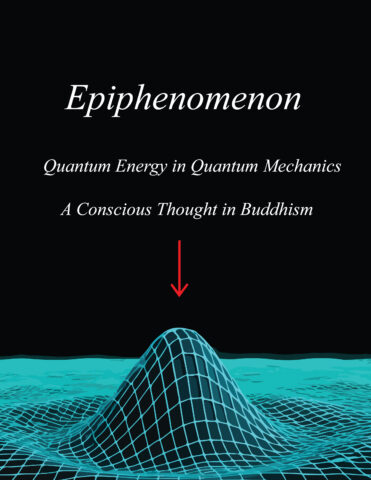
As discussed earlier, in quantum field theory, an epiphenomenon is a ripple in the quantum energy field. Therefore, by the definition of energy in physics, an epiphenomenon is a “quantitative property,” essentially a number in an equation. However, in Buddhism, an epiphenomenon is a ripple in non-luminosity, a field of consciousness. Therefore, as a ripple of consciousness, an epiphenomenon in Buddhism refers to a thought. It is an essential concept to grasp as we continue to try to understand the meaning of “every thought takes a form.”
As mentioned earlier, to understand and analyze the information entering the mind, the mind becomes very active. An active mentality means more turbulence. Turbulence generates larger ripples. According to quantum field theory, only when ripples in the quantum field are large enough to be “measured” can they be considered an epiphenomenon. Smaller waves that cannot be “measured” are just turbulence that cannot be measured.
The same concept applies in Buddhism. Only ripples in the mind large enough for Buddha to perceive directly count as thoughts. Thoughts that Buddha cannot perceive directly are just movements in the mind.
So, the “forms” referenced in the statement “every thought takes a form” refer to the external appearance of the thoughts large enough for the Buddha to perceive directly. Just like quantum mechanics cannot measure turbulence, there is also a limit to what can be directly perceived.
The word Buddha uses to indicate the external appearance of a thought large enough for Buddha to perceive directly is “image of thought.” For example, in his definition of direct perception, Buddha teaches that to understand a non-conceptual phenomenon, one must not “perceive its object through the medium of an image, as does thought.”
Since we are not currently discussing direct perception, but sensing through the senses, “images of thought” need not be prevented.
2) All forms are conscious
The reason that “all forms are conscious” should be clear by now. “All forms are conscious” because the “forms” are the “image of thought.” As “images of thought,” the “forms” are naturally conscious.
3) “Conscious thoughts are so minute and delicate that they cannot be held.”
“Conscious thoughts are so minute and delicate that they cannot be held” because they come in and out of existence at the speed of “billions of thoughts per second.”
To understand what happens next to the “forms of thought,” we go to the next Aggregate, the Aggregate of Consciousness (Romanized Sanskrit: Vijnanaskandha; Chinese: 識蘊).
iv) The Aggregate of Vijnanaskandha (Chinese: 識蘊).
The Aggregate of Vijnanaskandha (Chinese: 識蘊) is the Fifth of the Five Aggregates. To understand this fifth Aggregate, we turn to the Consciousness-Only School of Buddhism (Romanized Sanskrit: vijñanavada; Chinese: 唯識宗).
According to The Princeton Dictionary of Buddhism, “the cardinal doctrine of the Consciousness-Only School is that the objects of experience are mere projections of consciousness. Thus, all objects are mere representations, and all categories are mere designations. No object is the natural basis of its name; rather, the mind itself instead designates the object.”
So, there are no “inner eyes looking out,” as modern-day epistemology suggests. Instead, it is consciousness all the way. The consciousness that initially receives the “experiential contents” from the galaxy is the same consciousness that enables its becoming “reading in of the mind,” conceptualizes them into directly perceivable “forms of thought” “in ways we do not govern,” and also projects them to be “seen on the screen the world that we experience.”
v) The Aggregates of Rupa
The Aggregates of Rupa (Romanized Sanskrit: Rupaskandha; Chinese: 色蘊) is the first of the Five Aggregates, and it corresponds to “the world we experience,” the last of the five sensing steps in epistemology.
However, conceptualized as “images of thought” and appearing as “mere projections of consciousness,” Rupa lacks any “body” or “materiality.” Indeed, as the Buddha teaches in Mohe Zhiguan, there is no “materiality” in Rupa, because “all are essentially citta” in the cosmos.
Indeed, the five aggregates are not building blocks of being. Instead, they represent a process of observation that turns the invisible “experiential content” into the visible in “the world we experience.”
Because all five constituents of being in “the world we experience” are steps of observation, “the world we experience” is indeed observer-dependent.
Again, any enlightened individual can verify Buddha’s teaching because, when one becomes enlightened, one’s mind becomes quiescent. When the mind is quiescent, projections of consciousness cease because they require an active mind. Without projections of consciousness, the universe cannot form and therefore disappears. This is, of course, what Adyashanti experienced, as well as the two monks of the Tang Dynasty in China.
In the next post, we will use the story of Bodhisattva Avalokiteśvara, as recorded in the Heart Sūtra, to show how an advanced Bodhisattva can fulfill the Buddha’s soteriological goal through understanding the Five Aggregates.
(If you like this post, please subscribe, like it on our Facebook page, and share. Thank you.)