

After discussing inference, the Buddha’s first means of knowledge, from the latter-day epistemology perspective, the Buddha’s corresponding teaching in the Five Aggregates, and his view on the usefulness of inference in searching for an unchanging reality in the Kalama Sutta, this post explores direct perception, the Buddha’s way of understanding what he understands.
Direct perception (Romanized Sanskrit: pratyaksa; Chinese: 現量), according to The Princeton Dictionary of Buddhism, is “nonconceptual in the sense that it does not perceive its object through the medium of an image, as does thought.”
Pratyaksa is closely associated with another concept known as adhigamadharma (Chinese: 證法), which, according to The Princeton Dictionary of Buddhism, is “in Sanskrit, ‘realized dharma;’ one of the two divisions of the dharma or teaching of the Buddha,” which “leads to the direct realization (Romanized Sanskrit: Adhigama, Chinese: 証), rather than mere conceptual understanding.”
Simply put, direct perception aims to understand a “nonconceptual” object by avoiding perceiving it “through the medium of an image, as does thought.”
As Buddha teaches in the Five Aggregates, human sensing is a five-step process. Using observation of the world as an example of sensing, the five-step process begins when the eyes receive the “experiential contents” of the world, which immediately become “reading-in” of the mind, where they are “conceptualized in ways humans do not govern.”
The conceptualized “experiential content” then becomes “projections of consciousness,” which is then seen as “the world we experience.”
Furthermore, as the Buddha teaches in the Five Aggregates, conceptualization makes an invisible thought “take a form,” i.e., becoming a visible image. This is the meaning of “the medium of image, as does thought,” as defined in direct perception, and which must be prevented from occurring to perceive a nonconceptual phenomenon.
Because conceptualization requires the “reading in of the mind,” stopping conceptualization means stopping the “reading-in of the mind.” Since the “reading-in of the mind” requires an active mind, the mind must be made quiescent to prevent it. When conceptualization is stopped, the other remaining steps must also cease. In other words, neither “projections of consciousness” nor “the world we experience” can be “seen.”
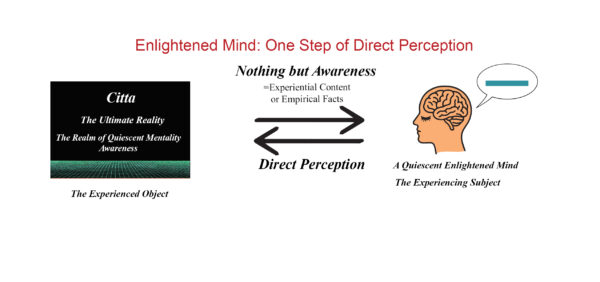
In other words, instead of having five steps when sensing with the senses with an active mind, direct perception is a one-step process with a quiescent mind.
To understand the details of direct perception, we start with Samadhi.
Samadhi (Chinese: 三昧/三摩地), according to The Shambhala Dictionary of Buddhism and Zen, is “a nondualistic state of consciousness in which the consciousness of the experiencing ‘subject’ becomes one with the experienced ‘ object ‘–thus is only experiential content. This state of consciousness is often referred to as ‘one-pointedness of mind’ this expression, however, is misleading because it calls up the image of “concentration” on one point on which the mind is “directed.” However, Samadhi is neither a straining concentration on one point nor is the mind directed from here (subject) to there (object), which would be a dualistic mode of experience.”
So, Samadhi is achieved when the “no-thought” mentality of the “experienced object” and the “no-thought” mentality of the “experiencing subject” form a nondualistic state of mentality. When that happens, one attains enlightenment.
What are the “experienced object,” and “experiencing subject?”
- “Experienced Object” refers to the two inconceivable realms of Citta and Rupa, which, as discussed in Post 3, Buddha teaches are “all essentially Citta.” In essence, “experienced object” includes the quiescent and active mind of the cosmos.
- “Experiencing Subject” refers to the “no thought” enlightened mind that an enlightenment seeker must achieve to form a nondualistic mentality with Citta.
- When the minds of the “experiencing subject” and “experienced object” become “nondualistic,” the “experiencing subject” can begin to experience the “experiential content” embedded in Citta and Rupa.
The significance of the enlightened individual’s mind forming a “nondualistic” state of mind of the cosmos is that the enlightened individual becomes one with the cosmos, as understood by Dr. Max Planck, a 1918 Nobel Prize Laureate in Physics and the originator of quantum theory. He came to the following conclusions after a lifetime of investigating quantum mechanics.
From the discussion in Post 4 on Buddha, we understand that the Buddha is one who has “opened his consciousness to encompass all objects of knowledge.”
Opening one’s consciousness is what enables the enlightened individual to perceive nonconceptual phenomena directly, because only by opening his consciousness can the enlightened individual form a “nondualistic” state of mind with the mind of the cosmos and experience its “experiential contents.”
“Experiential Contents” are, by definition, contents that can be “experienced.” They are the same as “all objects of knowledge” that an enlightened individual must encompass to become a Buddha, as discussed in Post 3. Moreover, whether known as “contents that can be experienced” or “all objects of knowledge that can be encompassed,” they are the same as what Dr. Fisch refers to as “empirical facts that can be felt.”
Furthermore, all three terms inform what Dr. Fisch calls “how things stand in themselves,” what Dr. Kuhn calls “what the world really is,” and what the Buddha calls “all objects of knowledge,” which an enlightened individual must understand before becoming a Tathagata, to be like the Buddha and fulfill his soteriological mission.
So, what are “all objects of knowledge” that one must encompass to be like the Buddha?
From our many discussions in the Why Buddhism Exists category, we understand that the Buddha’s soteriological goal is to liberate all sentient beings from their existential suffering. Suffering is existential because death inevitably follows birth. Therefore, liberating from existential suffering means existing without death.
To achieve that goal, the Buddha wants everyone to be like him and become a Tathagata. Everyone should become a Tathagata to understand “things as they are,” i.e., to encompass “all objects of knowledge.”
Encompassing “all objects of knowledge” comes at two major levels: overcoming the Afflictive Obstacles and the Cognitive Obstacles.
1) Overcoming the Afflictive Obstacles means understanding the illusory nature of the universe. That knowledge comes from initial enlightenment when all things deemed “physical” vanished, as experienced by Adyashanti and two prominent monks in ancient China, discussed in Posts 25 and 26 in the Verification Category. When one becomes enlightened, one becomes an Arhat.
The vanishing of the “physical” universe enables Arhats to experience its illusory nature.
A significant reward of becoming an Arhat is that they are “free from cycles of determinative birth-and-rebirth, Arhats enter parinamikajaramarana. (Chinese: 變易生死).” Also known as samsara (Chinese: 生死輪迴), liberation from cycles of determinative birth and death frees one from existential suffering.
Liberation from existential suffering means that death no longer follows birth for Arhats, who then enter parinamikajaramarana (Chinese: 變易生死), which, according to The Princeton Dictionary of Buddhism, means that “While such beings may then appear to be reborn, these rebirths are actually transfigurations of their mind-made bodies (Romanized Sanskrit: manomayakaya; Chinese: 意生身), which may be manipulated at will to change their appearances or to extend their life spans indefinitely.”
However, while the reward of enlightenment is tremendous, they have not fulfilled the Buddha’s soteriological goal because they have yet to overcome the Cognitive Obstructions by “perfecting their understanding of emptiness.” This work is reserved for advanced Bodhisattvas.
An example of how an advanced Bodhisattva perfected his understanding of emptiness, overcame his Cognitive Obstruction, and fulfilled the Buddha’s soteriological mission is discussed in Post 17.
By the time an advanced Bodhisattva fulfilled the Buddha’s soteriological goal, he had encompassed “all objects of knowledge.”
Between initial enlightenment and encompassing “all objects of knowledge” as a Tathagata, the examples of other objects of knowledge mostly consist of the Buddha’s detailed teachings on Citta and Rupa, discussed in their respective categories: the Citta Category and the Rupa Category.

In Buddhism, Citta is the realm of enlightened quiescent mentality that is the Ultimate Reality and Truth of the cosmos, the Experienced Object of Enlightenment, and where the cosmos expands. It is equivalent to the “dark energy” slice of the scientific universe as presented by NASA.
On the other hand, Rupa is the realm of an unenlightened, conscious field that is quantized, builds the dependently originated universe, and is where Buddhism and quantum mechanics first meet. It is equivalent to the quantum field in the “atomic” slice of the scientific universe as presented by NASA.
Because Citta and Rupa exist separately in their own realms, it is equivalent to saying that dark energy and the quantum field also exist separately in their own realm in the Buddhist universe. The significance of their separation is that it solves the Cosmological Constant Problem, deemed “the worst theoretical prediction in the history of physics.” Post 32 discussed this issue. Buddha also teaches four ways to understand reality between the two realms of Citta and Rupa. This is discussed in Post 33.
Then, of course, there are the Buddha’s teachings on Causality, located in the Causality category. Included in the Causality category is Post 36, which details the reincarnation story of an American fighter pilot in WWII. It is worth your time to look at because it will amaze you. If you do not believe in reincarnation when everything is deemed physical, you may want to reconsider when the mind is the real existence instead of a degenerable “physical” body.
As Adyashanti and the two monks in China show, all humans have the potential for enlightenment. The inherent ability of all humans to be enlightened is known as buddhadhatu in Romanized Sanskrit.
Buddhadhatu (Chinese: 佛性), according to The Princeton Dictionary of Buddhism, is “in Sanskrit, ‘buddha-element,’ or ‘buddha-nature,’ the inherent potential of all sentient beings to achieve Buddhahood.”
A person’s potential to achieve Buddhahood is consciousness, an active state of mind that every person possesses. When one can successfully calm one’s active mind to an inactive state, consciousness becomes awareness, and the person is enlightened. Enlightenment is not easy, but its potential lies within all humanity.
(If you like this post, please subscribe, like it on our Facebook page, and share. Thank you.)