

If you look out the window, see a beautiful world, and deem it real, you should know that Einstein allegedly said that “Reality is merely an illusion, although a very persistent one.” Additionally, do you know that quantum mechanics agrees and “suggests that reality at its fundamental level is uncertain, fluid, and dependent on observation.”
According to the Buddha, they are both right. Buddha teaches that the world is an illusion because its existence is indeed observer-dependent.
Buddha makes his viewpoint very clear in the Diamond Sūtra.
“All conditioned phenomena are like the illusions of dreams or shadows of bubbles (Chinese: 一切有為法, 如夢幻泡影),
Like dew or lightning, this is how to view them correctly.” (Chinese: 如露亦如電).”
As for the doctrine teaching that reality is observer-dependent, it is known as the Five Aggregates. It is too complex to explain here. If you are interested, please visit here.
However, in contrast to Einstein’s opinions or deductions from quantum mechanics, Buddha’s teachings are neither his opinions nor based on scientific theories. On the contrary, what Buddha teaches is what he actually realized to be natural phenomena. Furthermore, his teachings can be independently verified by third parties.
Many people are familiar with Buddhism, but few truly understand it. The purpose of this website is to outline Buddha’s teachings in detail. Contrary to popular belief, Buddhism is not a religion, philosophy, psychology, or science, even though its teachings overlap with these disciplines in some respects.
The purpose of this website is to suggest that Buddhism is a teaching from our historical Shakyamuni Buddha. Furthermore, with the help of quantum mechanics, particularly quantum field theory, and the contemporary philosophical understanding of epistemology, this website will introduce breakthrough insights into Buddhism’s core doctrines, culminating in the suggestion that Buddhism is unlike all other “-isms” in the world. Buddhism’s uniqueness lies in the fact that Buddha solves a problem that humanity has struggled to understand for thousands of years without success: the question of “What Exist?”
A) “What Exist?”
The question, “What Exists?“, is asked on Closer To Truth with the remarks, “Lots of things exist. But what’s truly fundamental? The challenge is to discern the minimum number of basic categories that explain the entirety of existence.”
B) “What Exists?” Humanity’s Continued Struggle to Understand
Indeed, asking “What Exists?” reflects humanity’s lack of a fundamental understanding of the reality in which it lives. In fact, humanity’s quest to understand the world started with pre-Socratic Greek philosophers.
One of these pre-Socratic Greek philosophers was Thales of Miletus, one of ancient Greece’s seven sages and a founding figure who accurately predicted a solar eclipse in 585 BC. According to Bryan Magee, author of The Story of Philosophy, “The question that most obsessed Thales was, ‘What is the world made of? It seemed to him that it must ultimately be made from a single element.” While he mistakenly assumed that the single element was water, Magee suggests that his insight was “amazing because the physics that led up to it had not yet been done.”
Pythagoras of Samos, a polymath well known for his eponymous Theorem, was another pre-Socratic ancient Greek philosopher who, according to Bryan Magee, “was the first person to have the idea that all the workings of the material universe are expressible in terms of mathematics.”
Since ancient Greece, humanity has depended on observation to investigate reality. However, understanding reality based on observation has never been reliable and is often subject to change.
Euclid was an ancient Greek mathematician and was considered the “father of geometry.” His geometry is called “planar geometry” because he thought the Earth was flat based on his observations. Later, when scientists found that the Earth is spherical, they expanded Euclid’s planar geometry to non-Euclidean geometry, which significantly helped navigation around the globe.
In the Middle Ages, geocentrism, the idea that the earth was at the center of the universe, with the sun, moon, stars, and planets revolving around it, was the predominant view regarding the shape of the universe. However, in the sixteenth century, Nicolaus Copernicus, a Renaissance astronomer and Catholic cleric, challenged the idea and proposed a mathematical model of heliocentrism, suggesting that the Earth orbits the Sun. Galileo Galilei then provided supporting evidence by observing the sky with a telescope.
Isaac Newton was the first scientist to propose that reality exists as solid particles. However, he never actually investigated whether the solid particles existed. According to author Fritjof Capra of The Tao of Physics, Newton wrote the following in his Opticks, “It seems probable to me that God in the beginning formed matter in solid, massy, hard, impenetrable, movable particles, of such sizes and figures, and with such other properties, and in such proportion to space, as most conduced to the end for which he formed them; and that these primitive particles being solids, are incomparably harder than any porous bodies compounded of them; even so very hard, as never to wear or break in pieces; no ordinary power being able to divide what God himself made one in the first creation.” The author added, “In the Newtonian view, God had created, in the beginning, the material particles, the forces between them, and the fundamental laws of motion.”
While Newton’s theory worked exceptionally well for hundreds of years and continues to be used, with the advent of quantum field theory in quantum mechanics, however, quantum scientists, such as Dr. David Tong of the University of Cambridge, came to realize that “there are no particles in the world,” as he firmly stated in his video lecture, “Quantum Fields: The Real Building Blocks of the Universe.”
In this video, How is the Cosmos Constructed, 2004 Nobel Laureate Dr. Frank Wilczek added more details, “The most basic objects out of which to construct the universe are not particles but objects we call quantum fields. We think of them as space-filling ethers that create and destroy the objects, the particles. …….. We see particles as epiphenomena. They are kind of ripples on the deep structure.” While Dr. Wilczek did not elaborate on the “deep structure,” we know the ripples are the ripples of the quantum fields he mentioned.
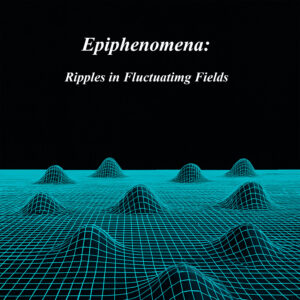
Waves in a fluctuating field are called epiphenomena because they are considered secondary phenomena arising from the primary phenomenon, which is the quantum field. The existence of the waves depends conditionally on the field being fluctuating. When the field ceases to fluctuate, particles also cease to exist.

The image above, from Dr. David Tong, shows ripples as epiphenomena and the field from which they arise.

The image above, courtesy of Dr. Tony Tyson of UC Davis, is shown in Dr. Lawrence Krauss’s lecture on “A Universe From Nothing.” According to Dr. Krauss, “The spikes are where the galaxies are.” However, the spikes, each representing a galaxy in the sky, are not shown as separate entities. Instead, they are shown as huge ripples in a field that connects them all. In other words, like the tiny ripples in Dr. Tong’s quantum energy field, these massive galaxies in the sky are also epiphenomena within it.
In other words, all phenomena in the universe —from the tiniest ripples in the quantum field to the giant galaxies in the sky — coexist with their unobservable epiphenomena of quantum energy that underlie them.
(In case you are wondering why the concept of epiphenomena is brought up in discussing Buddhism, it is because Buddhism has its own epiphenomena that are comparable to the quantum mechanical ones, as will be discussed later.)
So, what is quantum energy?
According to this article, energy, “in physics,” is a “quantitative property that is transferred to a body or a physical system, recognizable in the performance of work and in the form of heat and light.”
Furthermore, quantum “is a discrete quantity of energy proportional in magnitude to the frequency of the radiation it represents.”
In other words, quantum energy is a man-made quantitative tool that comes in discrete units and helps scientists investigate universal phenomena they deem to be “body” or “physical.” However, as a quantitative property, energy exists as numbers in equations, but not in nature. Therefore, while energy enables scientists to explain the world’s physical phenomena using mathematical expressions and satisfies Pythagoras’ insight “that all the workings of the material universe are expressible in terms of mathematics,” it does not inform them about “What Exists?” To put it simply, energy does not tell scientists what makes up the epiphenomena.
In this discussion on “What Exists,” four scientists were interviewed. Among them, there were four different views, ranging from a quantum physicist who believes that “the universe is a quantum mechanical wave function,” to one believing that consciousness has equal standing with physics, to one who thinks that reality is limited to what is only known to science, to a quantum physicist who believes in God. However, they were unable to express a unanimous opinion on “What Exist?”
More significantly, besides not understanding the physical world, the world of energy provides no knowledge of the never-observable, yet obviously present reality in all humans: their consciousness.
Indeed, in a world of energy, consciousness is nowhere to be found. Unable to find an answer in the physical universe, scientists start to wonder about consciousness and ask questions such as, “Is Consciousness Ultimate Reality?” “Is Consciousness Fundamental?” “Does Consciousness Cause the Cosmos?“, etc. Yet, as with “What Exists?” in the physical universe, physicists are also unable to answer these questions about consciousness. Indeed, after extensive dialogues with over 200 religious leaders, philosophers, and scientists worldwide to map the Landscape of Consciousness, the best a prominent scientist can offer is a taxonomy of consciousness, without ever establishing a consensus definition of consciousness. Indeed, even with the advent of Einstein’s Theories of Relativity and Quantum Mechanics, humanity continues to struggle, without success, with understanding “What Exists?”
However, a willingness to inquire whether consciousness is fundamental represents a significant step forward in humanity’s quest to understand “What Exist?”
Indeed, the Buddha answered “What Exists?” more than 2,600 years ago while meditating under the Bodhi Tree until he achieved enlightenment.
C) “What Exist?” Buddha Answers: Nothing but Mentality
The origin of the doctrine Nothing but Mentality is Mohe Zhiguan (Chinese:摩訶止觀), a “voluminous” and “comprehensive Buddhist doctrinal summa which discusses meditation and various key Buddhist doctrines. ….. It is particularly important in the development of Buddhist meditation….,” and “a major focus of the Móhē zhǐguān is the practice of Samatha (Chinese:止), meaning “calming or stabilizing meditation” and Vipassana (Chinese:觀), meaning “clear seeing or insight.” Most importantly, Mohe Zhiguan “is founded firmly on scripture; every key assertion of the text is supported by sūtra quotations.”
With “every key assertion of the text supported by sūtra quotations,” Mohe Zhiguan is comprehensive, highly credible, and authoritative.
In Mohe Zhiguan, Buddha teaches that, at the highest and most profound level of meditative state, one can have direct insight into the inconceivable realm, where there is
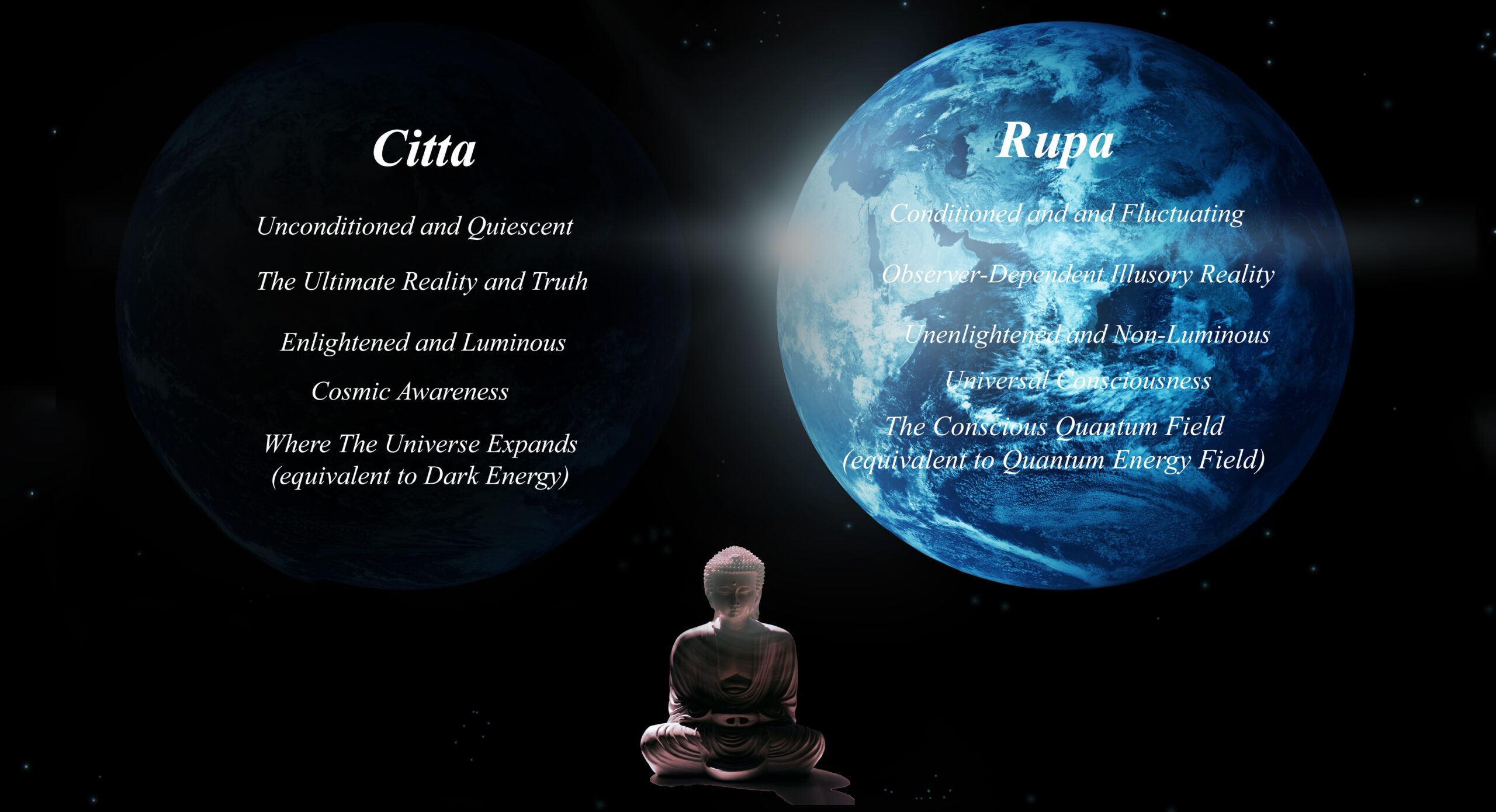
- “nothing outside of rupa and citta (Chinese: 不出色,心),
- “citta gives rise to rupa (Chinese: 色從心造),” and that
- all are essentially citta (Chinese: 全體是心).”
Citta (Chinese=心), according to The Princeton Dictionary of Buddhism, is “mind,” “mentality,” or “thought.” Furthermore, “Citta is contrasted with the physical body and materiality.”
Rupa (Chinese=色), according to The Princeton Dictionary of Buddhism, is “in Sanskrit and Pali, ‘body,’ ‘form,’ or ‘materiality,’ viz., that which has shape and is composed of matter. More generally, rupa refers to the materiality, which serves as the object of the five sensory consciousness (vijnana): visual, auditory, olfactory, gustatory, and tactile.”
In defining rupa as “body,” “form,” or “materiality,” and as the object of the visual, auditory, olfactory, gustatory, and tactile senses, the Buddha makes it clear that rupa refers to the universe humans experience.
So, what is the meaning that both citta and rupa are inconceivable?
Inconceivable (Romanized Sanskrit: acintya; Chinese: 不可思議), according to The Princeton Dictionary of Buddhism, is “in Sanskrit, a term used to describe the ultimate reality that is beyond conceptualization.”
“Beyond conceptualization” means that mentality is a reality that cannot be perceived, i.e., it cannot be seen, heard, smelled, tasted, or touched.
Natural gas is another example of a reality that is “beyond conceptualization.” Therefore, like mentality, it cannot be perceived.
Indeed, with citta being mentality, and rupa arising from mentality. Mohe Zhiguan concludes, “All are essentially citta.” These four words from the Mohe Zhiguan, “all are essentially citta,” are the foundation of the doctrine that there is “Nothing but Mentality (Chinese: 心外無法).”
The question, “What Exists?” requires that the answer be fundamental and that it “discerns the minimum number of basic categories that explain the entirety of existence.” Buddha’s answer satisfies both requirements. Not only is mentality fundamental, but it only consists of two categories that explain the entirety of existence: citta and rupa.
By teaching that mentality is the only fundamental reality in the cosmos, the Buddha realized Thales’ insight that everything in the universe could be composed of one element. However, Thales might not have anticipated that the component would be non-physical.
(To be Continued)
(If you like this post, please like it on our Facebook page and share. Thank you.)