

In this post, we discuss epiphenomena, where Buddhism meets quantum mechanics.
As discussed before, in this episode of Closer to Truth, Dr. Frank Wilczek, a 2004 Nobel Laureate in Physics, said, “The most basic objects out of which to construct the universe are not particles but objects we call quantum fields. We think of them as space-filling ethers that create and destroy the objects, the particles. …….. We see particles as epiphenomena. They are kind of ripples on the deep structure.”
In other words, while quantum fields have replaced particles as the fundamental building blocks of the universe, particles have become epiphenomena, secondary phenomena derived from ripples in the quantum fields.
Epiphenomena are called epiphenomena because they are considered secondary epiphenomena arising from the fluctuating quantum energy field, which is the primary phenomenon. The existence of epiphenomena is dependent on the quantum energy field fluctuating. If the quantum field stops fluctuating, epiphenomena cannot exist because there would be no ripples in a non-fluctuating field. While this concept is not applicable in quantum mechanics, as a non-fluctuating quantum field does not exist, it is a significant event in Buddhism because a non-fluctuating mentality signifies enlightenment.

The image above is from Dr. David Tong, “a British theoretical physicist,” and “a professor at the University of Cambridge,” and it shows ripples in a fluctuating quantum energy field. These ripples are epiphenomena.

The image above is from Dr. Tony Tyson, “an American physicist and astronomer, professor of the University of California, Davis, and chief scientist of the Vera C. Rubin Observatory.” Dr. Lawrence Krauss, “a Canadian-American theoretical physicist and cosmologist who taught at Arizona State University (ASU), Yale University, and Case Western Reserve University,” used this image in his 2009 video lecture, “A Universe From Nothing.” According to Dr. Krauss, in the image, “the spikes are where the galaxies are.” However, the spikes are not shown as individual entities. Instead, they are connected by a field beneath them. In other words, galaxies are also epiphenomena.
In other words, all phenomena in the world constructed from the quantum energy field, from the tiniest ripples in the quantum field to the giant galaxies in the sky, are all epiphenomena.
The same concept applies to non-luminosity. As a field of fluctuating mentality, non-luminosity has its ripples and, therefore, epiphenomena.
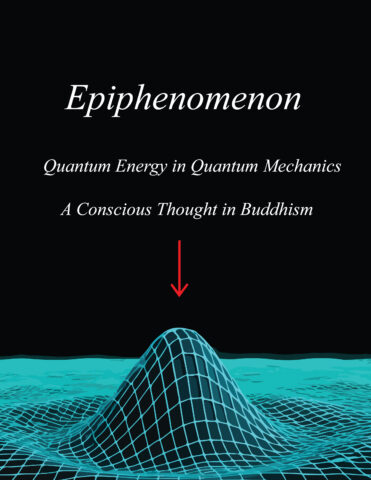
However, it is essential to note that, because what fluctuates in their respective fields differs, the meaning of an epiphenomenon is vastly different in quantum mechanics and Buddhism. Since energy fluctuates in a quantum energy field, its epiphenomena are “quantitave properties.” However, given that non-luminosity is a field of fluctuating mentality, and that consciousness is defined as a fluctuating mentality, non-luminosity is a field of consciousness. Therefore, as a ripple in consciousness, an epiphenomenon in non-luminosity signifies a thought, as indicated in the image below.
However, as far as it is known, the term “epiphenomena” does not appear in Buddhist sutras. On the other hand, there is a term in Buddhism that carries a meaning similar to that of a particle in science. That term is “dust (Chinese: 塵).”
Therefore, by describing particles as epiphenomena and associating them with ripples in a fluctuating field, Dr. Wilczek provides a critically missing link that makes it possible to understand that “dusts” are epiphenomena. Indeed, as discussed in the last post, in his doctrine known as the Twelvefold Chain of Dependent Origination, the Buddha teaches that everything in the universe arises from non-luminosity. This means that all things are ripples in non-luminosity and therefore, epiphenomena.
With that understanding, it is then possible to comprehend that all “dusts” are epiphenomena because they are all derived from non-luminosity.
In the Abhidharmakośakārikā (Chinese: 阿毗達磨俱舍論/俱舍論), “a key text on the Abhidharma written in Sanskrit by the Indian Buddhist scholar Vasubandhu (Chinese: 世親) in the 4th or 5th century CE,” Buddha lists twelve dusts. Furthermore, an additional dust is mentioned in 佛學大辭典, or the Chinese Encyclopedia of Buddhism, bringing the total number of “dusts” to thirteen.
The significance of these thirteen dusts is that five of the smaller ones align perfectly with the arrangement of particles in the Standard Model, as shown in the table below. If you are interested in knowing the details, please visit Post 16.
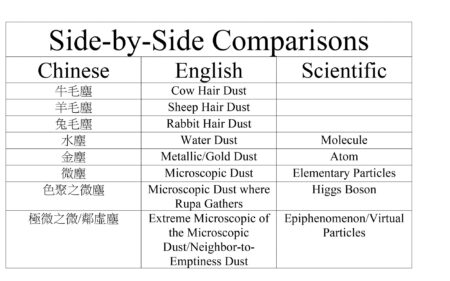
The focus of our discussion is on the tiniest “dust” on the list. Known as the “Extreme Microscopic of the Microscopic dusts (Chinese: 極微之微塵/極微塵), it is also known as “neighbor-to-emptiness dusts (Chinese: 鄰虛塵).
In the Śūraṅgama Sūtra (Chinese: 首楞嚴經), Buddha provides further details about the “neighbor-to-emptiness dust,” as he said, “If the ‘neighbor-to-emptiness dust’ is analyzed further, it would actually be emptiness (Chinese: 更析鄰虛,即實空性.).” Furthermore, as the table above shows, the “neighbor-to-emptiness dust” exists just below the “microscopic dust where Rupa gathers (Chinese: 色聚之微塵),” the equivalent of the Higgs Boson in science. (To understand why “microscopic dust where Rupa gathers” is equivalent to the Higgs Boson, please visit Post 16.) In other words, the “neighbor-to-emptiness dust” is the only “dust” without materiality.
This means that “neighbor-to-emptiness dust” is comparable to Dr. Tong’s epiphenomena in the image below: both are the only epiphenomena devoid of materiality in their respective teachings.
.
Now, we can explain the meaning of Buddha’s “If the ‘neighbor-to-emptiness dust’ is analyzed further, it would actually be emptiness.” As an epiphenomena without materiality, “neighbor-to-emptiness dusts,” like the epiphenomena in David Tong’s image, if “analyzed further,” is whatever fluctuates in the field it is in. In other words, if Dr. Tong’s epiphenomena are “analyzed further,” they would be “neighbor-to-quantum energy,” in the same way that if the “neighbor-to-emptiness dusts” are “analyzed further,” they would be emptiness, or mentality. This is the meaning of “neighbor-to-emptiness dust.”
To understand what is equivalent to the “neighbor-to-emptiness dust” in quantum mechanics, we turn to Buddha’s lecture to Ananda, who was “the primary attendant of the Buddha and one of his ten principal disciples.”
In the Śūraṅgama Sūtra (Chinese: 首楞嚴經), Buddha told Ananda, “Ananda, you still have not understood that all dusts floating and sinking are illusions transformed as observable phenomena, born here and annihilated the same here. (While these) Illusions are delusively considered as observable phenomena; their true nature remains enlightened and luminous. (Chinese: 阿難!汝猶未明一切浮塵諸幻化相,當處出生,隨處滅盡;幻妄稱相,其性真為妙覺明體).”
Let’s examine Buddha’s lecture to Ananda in detail.
1) All dust floating and sinking (Chinese: 一切浮塵).
To understand the meaning of “all dusts floating and sinking,” we turn to Dr. Tong and his descriptions of a quantum field in his lecture,” Quantum Field: The Real Building Blocks of the Universe.” In the lecture, Dr. Tong described quantum fields as “fluid-like substances which are spread throughout the entire universe and ripple in a strange and interesting way. That’s the fundamental reality in which we live.”
While Dr. Tong described a “ripple in a strange and interesting way” as the quantum energy field “spread throughout the universe,” Buddha describes something else because it is not a field. Instead, “all dusts floating and sinking” refers to epiphenomena in non-luminosity, which, like the quantum field, is “spread throughout the entire universe.“
2) Their nature remains enlightened and luminous (Chinese: 其性真為妙覺明體.).
To understand why Buddha deems the “true nature” of the “dust” “enlightened and luminous,” one needs to recall that, in Buddhism, an epiphenomenon signifies an active thought. Furthermore, while Buddha defines “no thought” as an enlightened thought and that “its essential original nature is transparently luminous,” he also teaches that an active mind is “defiled,” unenlightened, and non-luminous.
While Dr. Tong described a “ripple in a strange and interesting way” as the quantum energy field “spread throughout the universe,” Buddha describes something else because it is not a field. Instead, “all dusts floating and sinking” refers to epiphenomena in non-luminosity, which, like the quantum field, is “spread throughout the entire universe.“
3) “Born here, annihilated the same here (Chinese: 當處出生,隨處滅盡).“
The key to understanding the quantum-mechanical equivalent of “neighbor-to-emptiness” lies in the phrase “born here and annihilated the same here (Chinese: 當處出生,隨處滅盡).”
In other words, the speed of the annihilation of a “neighbor-to-emptiness dust” is so breakneck that the birth and annihilation of the dust practically occur at the exact location and time.
In the video presentation “Empty space is not Empty,” the host of the show, Veritasium, posted a supercomputer-generated simulation by Dr. Derek Lienweber of the University of Adelaide of what “empty space is not empty” looks like.
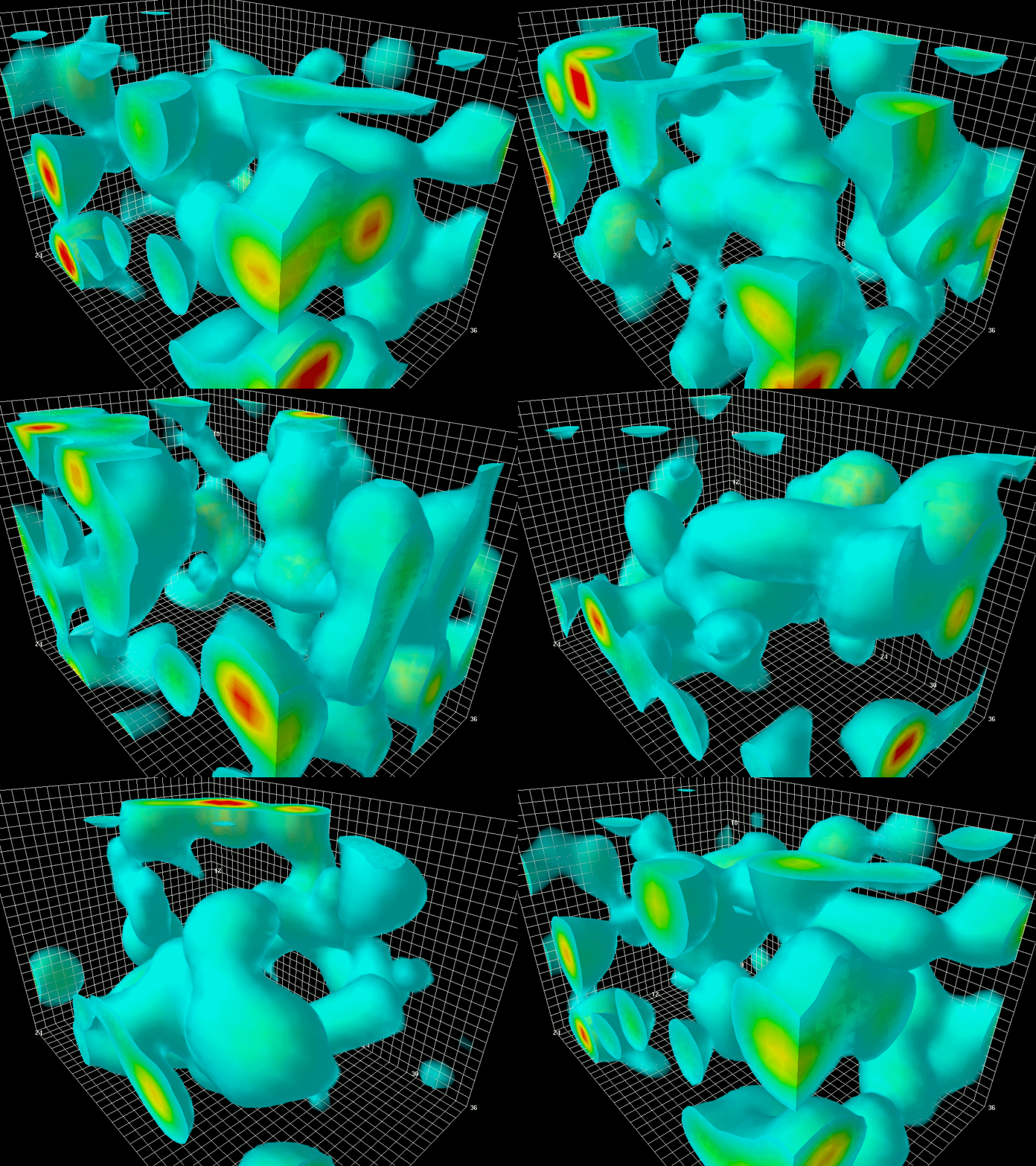
According to Dr. Lienweber, “empty space is not empty” because the “empty space is actually full of this quark-and-gluon field fluctuations. And, on average, it is possible to annihilate a quark from empty space ’cause it is not empty.”
So, how fast are the quarks being annihilated?
According to Veritasium, “The framerate of this simulation is one million billion billion frames per second. Now that is truly high speed.”
Indeed, as Veritasium said, the quarks being destroyed at the speed of “one million billion billion frames per second” is “truly high speed.” Without a doubt, it is as “truly high speed” as the “neighbor-to-emptiness dust” being annihilated at the speed of “born here, annihilated the same here.”
So, if we use the speed of their annihilation as the measure of comparison, we can be confident that “neighbor-to-emptiness dust” in Buddhism and quarks in quantum mechanics are equivalent, meaning that quarks and “neighbor-to-emptiness dusts” are where Buddhism and quantum mechanics first meet at their respective fields.
Another thing to understand about quarks is that they are also called “virtual particles.” The reason they are virtual is that, like the “neighbor-to-emptiness dust,” they are also without materiality.
(If you like this post, please like it on our Facebook page and share. Thank you.)