

After discussing inference, the Buddha’s first means of knowledge in an earlier post, this post explores direct perception, the Buddha’s second means of knowledge, and the path to enlightenment.
Direct perception (Romanized Sanskrit: pratyaksa; Chinese: 現量), according to The Princeton Dictionary of Buddhism, is “nonconceptual in the sense that it does not perceive its object through the medium of an image, as does thought.”
Pratyaksa is closely associated with another concept known as adhigamadharma (Chinese: 證法), which, according to The Princeton Dictionary of Buddhism, is “in Sanskrit, ‘realized dharma;’ one of the two divisions of the dharma or teaching of the Buddha,” which “leads to the direct realization (Romanized Sanskrit: Adhigama, Chinese: 証), rather than mere conceptual understanding.”
To put it simply, the purpose of direct perception is to avoid a “mere conceptual understanding” of its perceived observed object by avoiding “thought.” Since avoiding thought is the state of “no thought,” direct perception can occur only when the individual is enlightened and the mind is quiescent, as per the Buddha’s definition, as discussed in detail in Post 7.
We will use the following image to explore direct perception by comparing it to the five steps of sensing outlined in Post 23.
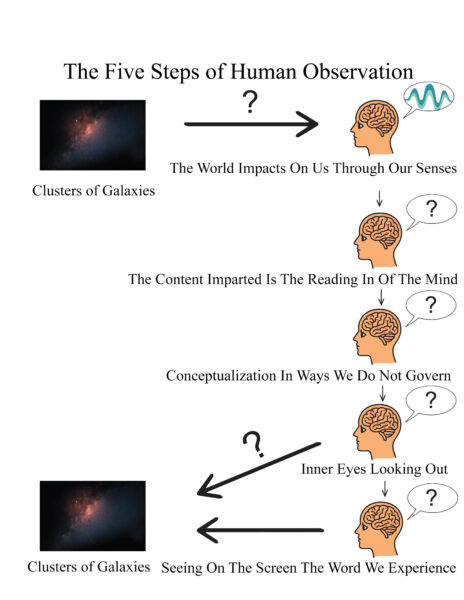 As we did in Post 23, we use observation as an example of sensing and a distant galaxy as the observed object. As the mage above shows, according to Dr. Fisch, human sensing of the world starts when “the distant galaxy impacts on us in a causal manner through all our senses.” Immediately, the contents that the eyes sense become the “reading in” of the mind, where they are “conceptualized in ways we do not govern.” Finally, through “inner eyes looking out,” the conceptualized contents are then “seen on the screen” as “the world we experience.”
As also discussed in Post 23, humans use inferentially connected word-based knowledge to understand “the world we experience.” Therefore, word-based knowledge can only lead to conceptual understanding of “the world we experience” because it has already been “conceptualized in ways we do not govern” by the time humans try to understand it.
However, the “reading in of the mind” requires an active mind to complete. Therefore, by requiring the mind to be quiescent, direct perception prevents the “reading in of the mind” from occurring. When the “reading in of the mind” does not happen, “conceptualization in ways we do not govern,” as well as the other remaining steps, must also cease. Of course, it means that “the world we experience” cannot manifest either. This is why the hallmark of a Buddhist enlightenment is the vanishing of the universe, all verified by all three enlightened people in Posts 10 and 11 in the Verification Category.
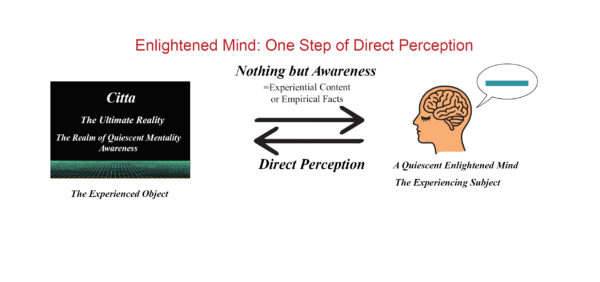
As shown in the image above, direct perception is a one-step process rather than a five-step sensing process. Direct perception leads to a nonconceptual understanding of its perceived object because conceptualization is not part of the process.
So, what is the perceived object of direct perception? The answer is Citta, the quiescent mentality of the Ultimate Reality.
To understand why Citta is the perceived object of direct perception, one must understand its role as the “experienced object” of enlightenment through Samadhi.
Samadhi (Chinese: 三昧/三摩地), according to The Shambhala Dictionary of Buddhism and Zen, is “a nondualistic state of consciousness in which the consciousness of the experiencing “subject” becomes one with the experienced “object” – thus is only experiential content. This state of consciousness is often referred to as “one-pointedness of mind;” this expression, however, is misleading because it calls up the image of “concentration” on one point on which the mind is “directed.” However, samadhi is neither a straining concentration on one point nor is the mind directed from here (subject) to there (object), which would be a dualistic mode of experience.”
So, Samadhi is achieved when the “no-thought” mentality of the “experienced object” and the “no-thought” mentality of the “experiencing subject” merge into a nondualistic state of mentality. When that happens, one attains enlightenment.
What are the “experienced object,” and “experiencing subject?”
- “Experienced Object” refers to the Citta, the quiescent mentality of the Ultimate Reality. Because Citta is quiescent, it is, by Buddha’s definition, “no thought” and enlightened. Therefore, Citta, as the enlightened mentality spread throughout the cosmos, is the always-present “experienced object” of enlightenment ready to form a nondualistic mentality with any enlightened individual at any time and in any place. As the “experienced object,” Citta is the source of the “contents” that can be “experienced” by the enlightened individual.
- The fact that this List of Enlightened People includes Buddha from what is nowadays Nepal more than 2600 years ago, Dharma Master Hui-Neng from the Tang Dynasty in China, and Adyashahti, a contemporary American, is confirmation not only of the existence of Citta, but also of its spread throughout.
- “Experiencing Subject” refers to the “no thought” enlightened mind that an enlightenment seeker must achieve to form a nondualistic mentality with Citta. As the “experiencing subject,” the enlightened individual is the “subject” who can “experience” the “content” that Citta contains when the two become one upon enlightenment.
What are “experiential contents?” “Experiential Contents” are, by definition, contents that can be “experienced.” They are the same as “all objects of knowledge” that an enlightened individual must encompass to become a Buddha, as discussed in Post 3.
However, whether it is known as “contents that can be experienced” or “all objects of knowledge that can be encompassed,” both terms refer to information embedded in the conscious epiphenomena that underly all phenomena in the world. As discussed in many earlier posts, all phenomena in the world, from tiny ripples in the quantum field to giant galaxies in the sky, co-exist with their underlying conscious epiphenomena.
Let’s take a galaxy as an example. Assuming that you know what a galaxy looks like, you know a galaxy is a galaxy the next time you see it in the sky without needing to be reminded. This is because the information about the galaxy comes from its epiphenomena. Furthermore, you would not call the moon next to the galaxy a galaxy because the information about the galaxy is embedded in its epiphenomenon, but not in the moon, which has its own epiphenomenon. It is the same with anything you look at, whether it is a dog, cat, river, mountain, or flowers; the specifics of each are embedded in their respective conscious epiphenomena.
So, what knowledge can the enlightened individual learn from Citta?
Well, we can get the answer from those who have been enlightened.
In the Verification Category, you can find the enlightenment experiences of three individuals. A common feature that all three can verify is the disappearance of the universe upon their enlightenment. It is the hallmark of Buddhist enlightenment because, as mentioned earlier, when the mind is quiescent, the universe cannot manifest.
As discussed in Post 10, Adyashanti, being a contemporary, was able to describe his enlightenment in a more nuanced manner using latter-day vocabulary. Notably, after his enlightenment, he acknowledges that “You are awareness,” “you and awareness are not two different things,” and that “resting in awareness is not a state of doing, it is a state of being.”
These acknowledgements are significant because
- By equating “you” with “awareness,” Adyashanti shows that he recognizes awareness as the essence of his existence, not his physical body. This aligns with Buddha’s teaching in Mohe Zhiguan, “all are essentially citta (mental)(Chinese: 全體是心).”
- By acknowledging that “you and awareness” while in the “void” he was in upon his enlightenment, Adyashanti shows that he and Citta have indeed become a “nondualistic” mentality because, as a quiescent mentality, Citta is the definition of awareness.
Dr. Max Planck was a 1918 Nobel Prize Laureate in Physics and the originator of quantum theory. He came to the following conclusions after a lifetime of investigating quantum mechanics.
Indeed, Dr. Planck was right on both counts. Not only is consciousness fundamental to the universe, but one must also be part of the mystery to solve the mystery. By forming a nondualistic mentality with Citta, the enlightened individual indeed becomes part of the mystery that humanity has struggled to understand since the time of pre-Socratic Greece, the mystery of “What Exists?”
Buddha teaches that all humans have the ability to become enlightened. The inherent ability of all humans to be enlightened is known as buddhadhatu in Romanized Sanskrit.
Buddhadhatu (Chinese: 佛性), according to The Princeton Dictionary of Buddhism, is “in Sanskrit, ‘buddha-element,’ or ‘buddha-nature,’ the inherent potential of all sentient beings to achieve Buddhahood.”
A person’s potential to achieve Buddhahood is consciousness, a state of active mentality that every person possesses. When one can successfully calm one’s active mind to an inactive state, consciousness becomes awareness, and the person is enlightened. While enlightenment is not easy, the potential to be enlightened is within all humanity.
(If you like this post, please like it on our Facebook page and share. Thank you.)