

In this post, we discuss the Cosmological Constant Problem and why it cannot exist in the cosmos Buddha teaches.
To understand the Cosmological Constant Problem, one needs first to know what the Cosmological Constant is.
The Cosmological Constant “is a coefficient that Albert Einstein initially added to his field equations of general relativity. He later removed it; however, much later, it was revived to express the energy density of space, or vacuum energy, that arises in quantum mechanics. It is closely associated with the concept of dark energy.” Furthermore, “many physicists believe that ‘the vacuum holds the key to a full understanding of nature.”
Dark energy is, “In physical cosmology and astronomy, dark energy is a proposed form of energy that affects the universe on the largest scales. Its primary effect is to drive the accelerating expansion of the universe.”
Edwin Hubble was among the first to recognize that the universe was expanding in the 1920s. Furthermore, on March 15, 1929, Hubble published his observation that the expansion of the universe was accelerating.
So, when Einstein first published his General Theory of Relativity in 1915, he had no idea that the universe was expanding. Therefore, he did not conceive the term that would later carry his name in his equation. However, in 1917, he introduced the mathematical term into his field equations of general relativity to conform to the then-accepted scientific view that the universe was static, assigning it a negative value. Unfortunately, by 1931, science no longer deems the universe static but expanding. Einstein then abandoned his term, believing its value to be zero. By the late 1990s, however, scientists discovered that the expansion of the universe was accelerating. Einstein then reintroduced the term into his field equations of general relativity, “implying the possibility of a positive, nonzero value for the cosmological constant.” That value remains positive until today. Later, he would call this whole episode his “biggest blunder.”
Today, the value of Einstein’s Cosmological Constant has been measured and is “in excellent agreement” with that obtained from a theoretical model. Einstein’s Cosmological Constant is now officially positive.
The Cosmological Constant Problem is “In cosmology, the cosmological constant problem or vacuum catastrophe is the substantial disagreement between the observed values of vacuum energy density (the small value of the cosmological constant) and the much larger theoretical value of zero-point energy suggested by quantum field theory.” Furthermore, described as “‘the largest discrepancy between theory and experiment in all of science’ and ‘probably the worst theoretical prediction in the history of physics,'” the discrepancy of the Cosmological Constant Problem between theory and experimental result “is calculated to be between 50 and as many as 120 orders of magnitude.”
According to this article, “Vacuum energy is an underlying background energy that exists in space throughout the entire universe. The vacuum energy is a special case of zero-point energy that relates to the quantum vacuum.” Furthermore, according to this article, “the quantum vacuum state (also called the quantum vacuum or vacuum state) is the quantum state with the lowest possible energy. Generally, it contains no physical particles.”
In other words, the substantial discrepancy that causes the Cosmological Constant Problem stems from the conflict between wanting the quantum state to have “no physical particles” and the “much larger theoretical value” obtained from quantum field theory.
According to quantum field theory, physical particles no longer exist as quantum fields have replaced them as the foundational blocks of the universe. For example, in his video lecture named “Quantum Fields: The Real Building Blocks of the Universe,” Dr. David Tong of the University of Cambridge said firmly that “there are no particles in the world.” Furthermore, in this episode of Closer to Truth, Dr. Frank Wickek, a 2004 Nobel Laureate physicist, made it very clear to his host: “The most basic objects out of which to construct the universe are not particles but objects we call quantum fields.” We see particles as epiphenomena. They are kind of ripples on the deep structure.“
In other words, quantum fields have replaced particles as the fundamental building blocks of the universe, and particles have become epiphenomena, ripples in the quantum fields.
Therefore, in quantum field theory terms, to have “no physical particles” is to have no epiphenomena. And for there to be no epiphenomena, the quantum field must not fluctuate.
However, this is a problem in the NASA universe because a quantum field that does not fluctuate does not exist.

To understand why that is the case, one must first understand a concept called “empty space is not empty.” According to the host of the video named “Empty Space is Not Empty,” Veritasium, “Empty space is not truly empty… because I have seen it.” What he referred to was the following short supercomputer-generated simulation by Professor Derek Leinweber of the University of Adelaide.
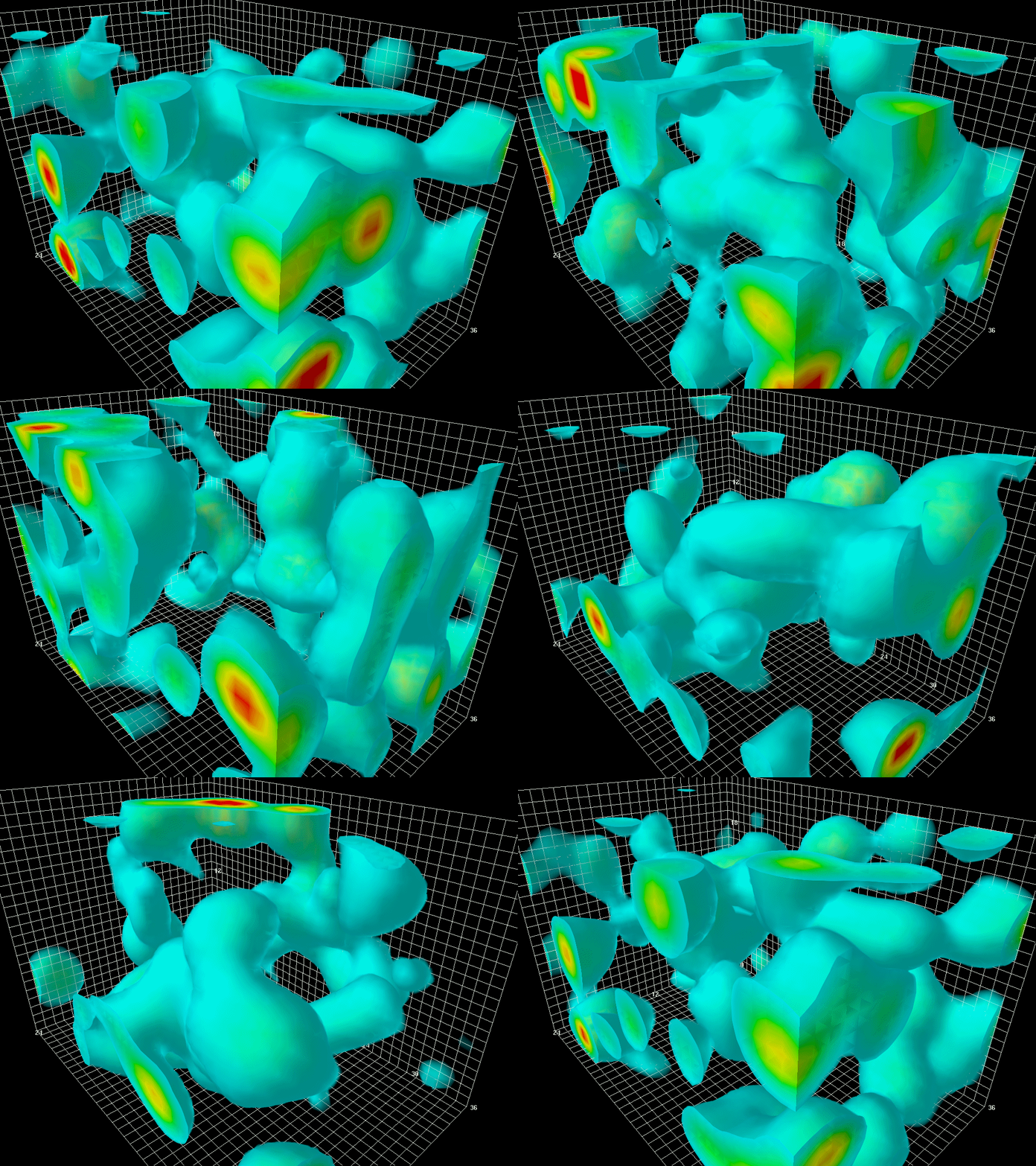
Veriitasium continued, “What we see is a bubbling soup of quantum field fluctuations that come and go incredibly quickly. The frame rate of this simulation is one million billion billion frames per second.” “This is a simulation of the vacuum on its own, what we normally think of as “empty” space.” Now it seems counterintuitive that the vacuum at its lowest energy state should contain all this stuff.”
In other words, the reason why “empty space is not empty” is that “what we normally think of as ’empty space'” is actually full of quantum field fluctuations. Simply put, a quantum field that does not fluctuate does not exist in the universe.
If we put the Cosmological Constant Problem in quantum field terms, it means that the Cosmological Constant Problem arises because, while scientists would like a vacuum state without quantum fluctuations, no such state exists in reality, as quantum field fluctuations are ubiquitous.
Therefore, instead of considering the Cosmological Constant Problem a conflict between observation and theory, it could, from a Buddhist perspective, be a structural problem. Indeed, it is a structural problem that would not exist if the realms with and without fluctuations were separate.
Separating the realm with and without fluctuations is precisely how Buddha’s mental cosmos is structured.
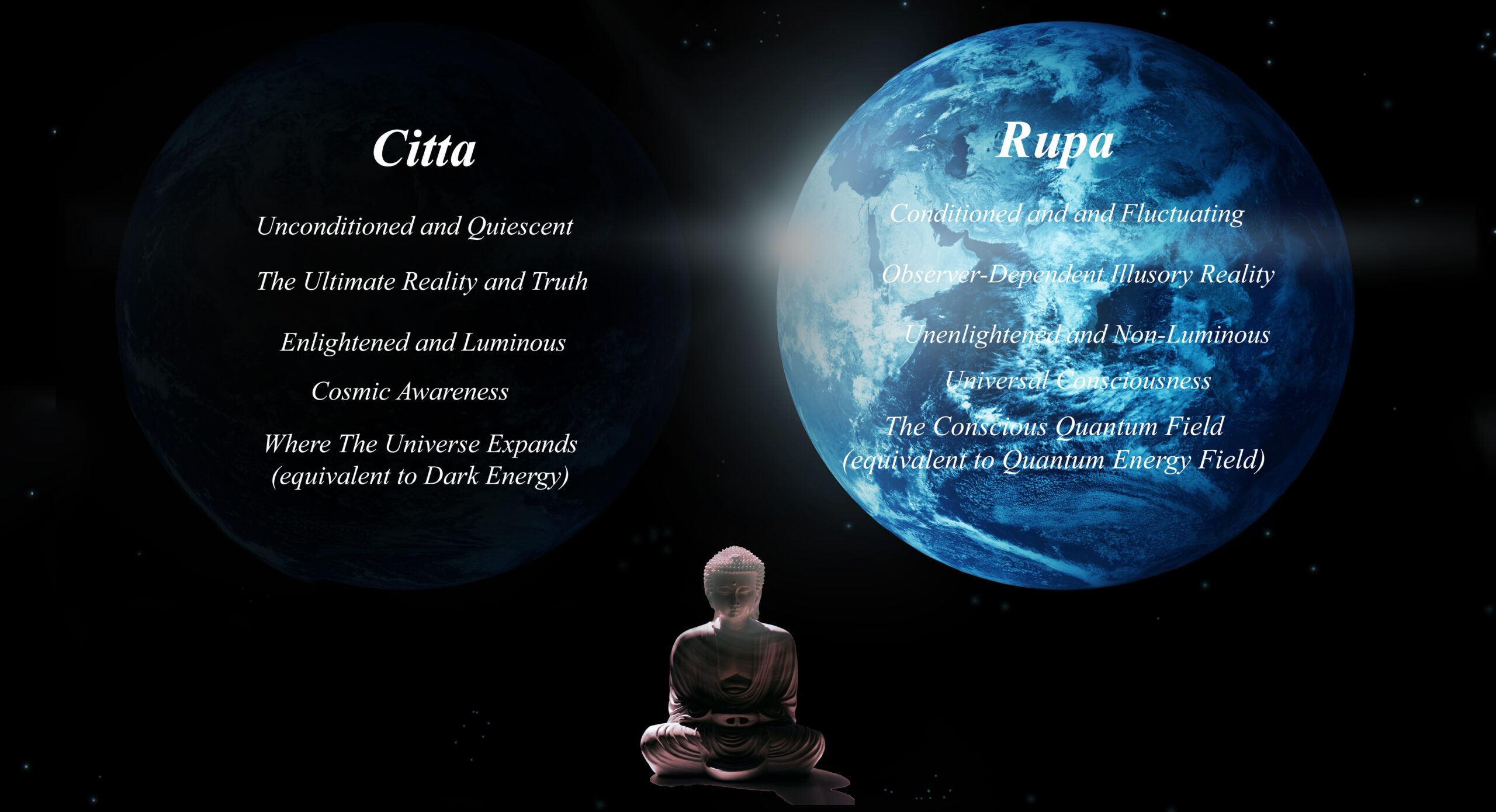
As discussed in many earlier posts, the two realms of reality in the mental cosmos, Citta and Rupa, are separated by their different states of fluctuation. Citta is a quiescent mentality that never fluctuates, while Rupa is a mentality that fluctuates incessantly. Indeed, with a setup that separates the realms with and without fluctuations, the Cosmological Constant Problem cannot exist.
As discussed in Post 9, Buddha realized that the expansion of the universe occurs in the Ultimate Reality, thus making the Ultimate Reality equivalent to dark energy.
However, for the Ultimate Reality to be completely equivalent to dark energy, we must know.
1. “Can the Ultimate Reality have a Cosmological Constant, like dark energy?”
-
- The answer is definitive. As an unconditioned phenomenon, the Ultimate Reality is perduring and unchanging. Its unchanging nature means that, if the Ultimate Reality has a value, it can only be a constant.
2. “Can the Ultimate Reality be ‘the vacuum that holds the key to a full understanding of nature?'”
-
- Again, the answer is definitive. After all, it is the Ultimate Reality. As discussed in Post 6, Buddha, as a Tathagata, understands “things as they are.” Buddhism, as Buddha’s teaching, teaches “things as they are.” Understanding Buddhism is understanding “things as they are,” which is “a full understanding of nature.”
(If you like this post, please like it on our Facebook page and share. Thank you.)