

In this post, we discuss namarupa, a term Buddha uses to indicate that all Rupa are Rupa in name only.
As discussed in Post 4, Rupa (Chinese: 色), according to The Princeton Dictionary of Buddhism, is “in Sanskrit and Pali, ‘body,’ ‘form,’ or ‘materiality,’ viz., that which has shape and is composed of matter. More generally, rupa refers to the materiality, which serves as the object of the five sensory consciousness (vijnana): visual, auditory, olfactory, gustatory, and tactile.”
The term namarupa first appears as the fourth link in the Buddha’s Twelvefold Chain of Dependent Origination, known in Romanized Sanskrit as pratityasamutpada.
Pratityasamutpada (Chinese=緣起), according to The Princeton Dictionary of Buddhism, is “in Sanskrit, ‘dependent origination, ‘conditioned origination,’ lit. ‘origination by dependence’ (of one thing on another): one of the core teachings in the Buddhist doctrinal system, having both ontological, epistemological, and soteriological implications.” Furthermore, “in one of the earliest summaries of the Buddha’s teachings (which is said to have been enough to bring Sariputra to enlightenment), the Buddha is said to have taught:” “When this is present, that comes to be. /From the arising of this, that arises. / When this is absent, that does not come to be. / From the cessation of this, that ceases.”
As discussed earlier, in the Twelvefold Chain of Dependent Origination, Buddha teaches that the lifecycles of all phenomena in the universe, from their origin to their demise, follow twelve interconnected links. Each link serves as the cause (Romanized Sanskrit=nidana, Chinese=因緣/尼陀那) for the origination of the following link until the lifecycle ends.
The twelve interconnected links are:
i) Non-luminosity (Chinese: 無明)
ii) Samskara (Chinese: 行)
iii) Vijnana (Chinese: 識)
iv) Namarupa (Chinese: 名色)
v) Sadayatana (Chinese: 六入)
vi) Sparsa (Chinese: 觸)
vii) Vedana (Chinese: 受)
viii) Trsna (Chinese: 愛)
xi) Upadana (Chinese: 取)
x) Bhava (Chinese: 有)
xi) Jati (Chinese: 生)
xii) Jaramarana (Chinese: 老死)
The focus of our current discussion is on the first four links of the Twelvefold Chain of Dependent Origination.
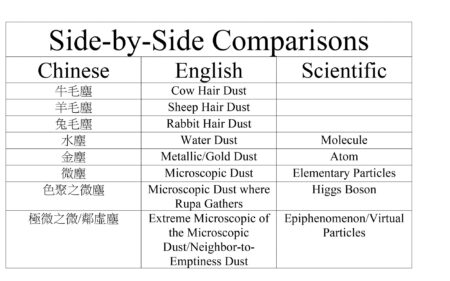
1) Non-luminosity (Chinese: 無明). As discussed in many earlier posts, non-luminosity refers to a realm of fluctuating mentality permeating the universe. Furthermore, non-luminosity is uniquely qualified to serve as the first link in the Twelvefold Chain of Dependent Origination because it is “noncausal (Chinese: 非因緣)” and “without beginning (Chinese: 無始無明),” meaning it exists naturally without being caused by external factors and eternally without a beginning or end. Furthermore, its epiphenomena, known as “neighbor-to-emptiness dust (Chinese: 鄰虛塵),” are the tiniest in the universe and situated in the lowest part in Buddha’s arrangement of all the “dusts” mentioned in Buddhist sutras, as shown in the following table. It is also uniquely the only “dust” without rupa.
2) Samskara (Chinese: 行), meaning action, refers to one of the five steps of human observation in Buddha’s teachings known as the Five Aggregates. Action refers to the fact that information from the external world, as sensed by the eyes, is conceptualized, i.e., distorted in the brain by turning what is initially invisible into a visible form.
3) Vijnana (Chinese: 識), meaning consciousness, is also one of the five steps of human observation in Buddha’s teaching known as the Five Aggregates. The role of consciousness is to project the already-conceptualized forms as the visible myriad phenomena in the world.
As discussed in Post 15, in his doctrine known as the Three Delicate Marks, Buddha teaches that observation makes the external world visible. Understanding how that happens requires understanding the Five aggregates. However, the Five Aggregates are complex, and discussing them in detail is beyond the scope of this post. The essential thing to understand now for our current discussion is that observation makes possible the transformation of the first link, a “neighbor-to-emptiness dust,” into a namarupa in the fourth step. If you wish to understand the Five Aggregates now, please visit this post.
4) Namarupa (Chinese: 名色), a compound word composed of two Sanskrit words, nama and rupa, is the fourth link in the Twelvefold Chain of Dependent Origination.
Nama, according to this answer to the question, “What is the meaning of ‘nama’ in the Sanskrit?”, Naman, is “‘Nama’ (with long initial ‘a’) means name and is found in compounds both at the beginning and at the end, e.g.: Namakarana – naming ceremony.”
In other words, a namarupa is a Rupa named as a Rupa, or Rupa in name only. Indeed, that is what the Chinese translation, “名色,” means.
In other words, namarupa is not only a “dust” that contains rupa, but also a term that applies to all “dusts” that contain rupa. If that is the case, then the first “dust” to be called a namarupu must be the first dust to contain rupa.
Before we move on, it is essential to point out that, since links 2 and 3 are steps in observation, they are not “dusts.” By skipping these two links, it shows that the relationship between the “neighbor-to-emptiness dust” and namarupa in the Twelvefold Chain of Dependent Origination is the same as the relationship between “neighbor-to-emptiness dust” and the “microscopic dust where rupa gathers (Chinese: 色聚之微塵).,” as we discussed in the previous post using the table below: namarupa and the “microscopic dust where rupa gathers” are both not only one level from the “neighbor-to-emptiness dust,” but also to have rupa in Buddhism.
This is essential because it leads to understanding that namarupa is the “microscopic dust where rupa gather,” which is indeed the first dust to contain rupa in Buddhism.
In the previous post, we also discussed that the “microscopic dust where rupa gathers“ is equivalent to the Higgs Boson because both are the first to contain matter in Buddhism and science, respectively. However, for them to be comparable, it is necessary that if the “microscopic dust where rupa gathers” is a namarupa and devoid of matter, then the Higgs Boson must also be devoid of matter, which, in science, is known as mass, a scientific term indicating the presence of matter. In other words, if “microscopic dust where rupa gathers” is a namarupa, the Higgs Boson must be a nama-mass, i.e., a mass in name only.
To understand that, we turn to science and examine how a Higgs boson acquires mass. This short video, 3.18 minutes long, titled “What is a Higgs Boson?” explains the scientific mechanism behind the Higgs Boson in an easy-to-understand way. Simply put, according to this video, a massless particle gains mass by interacting with a field called the Higgs Field.
The video uses swimming as an analogy for the interaction between a Higgs Boson and the Higgs Field, with water representing the Higgs Field. When the swimmer is a supremely streamlined barracuda, it interacts with water only slightly and moves through it easily. In scientific terms, the barracuda would be considered a low-mass particle. On the other hand, if the swimmer is an overweight large person, he would move through the water much more slowly. In scientific terms, the overweight person would be considered a massive particle. However, in both cases, by swimming through water, neither the garracuda nor the overweight person gains anything. It is like swimming through a liquid medium of different thicknesses: instead of gaining weight, one feels different resistances as one swims through it.
So, indeed, like “microscopic dust where rupa gathers” is a namarupa, the Higgs Boson is a nama-mass, mass in name only.
However, it is also essential to note that, while swimming through media of different thicknesses does not gain anything from a Buddhist perspective, from a scientific standpoint, mass can be derived from mathematical relationships among inferentially connected manifestations of energy.
On July 4, 2012, the existence of the Higgs Boson was confirmed. On October 8, 2013, the Nobel Prize in Physics was awarded to Drs. Peter Higgs and Francois Englert.
However, if one searches for “Was the Higgs Field ever discovered?” one would likely get an answer similar to the one I received: “The Higgs field was confirmed through the discovery of the Higgs boson on July 4, 2012, at CERN’s Large Hadron Collider. This discovery validated the existence of the Higgs field, which is responsible for giving mass to elementary particles.”
In other words, the existence of an Higgs Field was never confirmed directly. Instead, its existence is circularly validated by the existence of a Higgs Boson, which the Higgs Field creates.
Compare this to what is written in Romans 1:20 in the New American Standard Bible, “For since the creation of the world His invisible attributes, His eternal power and divine nature, have been clearly seen, being understood through what has been made, so that they are without excuse.”
Of course, there is no He in science. Instead, in His place is energy, which is defined with a similar idea in mind: to understand the physical world, know it circularly through energy, which scientists have created, as shown below.
Energy, “in physics,” is a “quantitative property that is transferred to a body or a physical system, recognizable in the performance of work and in the form of heat and light.”
This is not a statement meant to denigrate science. However, it is a statement about the limitations of human understanding of reality when relying on word-based knowledge to grasp the reality humans face. We will tackle how, while word-based knowledge enables understanding of how things relate to one another, it does not answer “What Exists?” in our discussion of How Do We Know What We Know in Post 23, as we explore epistemology.
(If you like this post, please like it on our Facebook page and share. Thank you.)