


We discuss the Observer Effect in this post. The Observer Effect is associated with the Double-Slit Experiment and was discovered in 1801 by the British polymath Thomas Young (1773-1829).
The animated introduction in the TED-Ed video explains the link between the double-slit experiment and why physicist Richard Feynman (1918-1988), a 1965 Nobel Laureate, called it the Central Mystery of Quantum Mechanics.
The video begins with the statement: “One of the most amazing facts in physics: everything in the universe, from light to electrons to atoms, behaves like a particle and wave at the same time.” After a brief historical introduction to how atoms and electrons can behave as particles and waves simultaneously, the video discusses the double-slit experiment.
The experiment involves shooting single electrons at a barrier with two slits cut into it. “Each electron is detected at a specific place at a specific time, like a particle. But when you repeat the experiment many times, all the individual electrons trace out a pattern of stripes, characteristic of wave behavior. The idea that particles behave like waves, and vice versa, is one of the strangest and the most powerful in physics. Richard Feynman famously said that this illustrates the central mystery of quantum mechanics.”
With the behavior of a single electron/photo double slit experiment clarified, we discuss the Observer Effect.
This short but clear video, titled “Greatest Proof We’re In a Simulation,” used the same experiment as above, but with single photons instead of electrons and a barrier with two slits. After explaining the experiment, a scientific detector is used to “observe” the waves as they pass through the two slits. Unexpectedly, instead of showing interference patterns suggestive of waves, as in the previous experiment, the result was two bands suggestive of particles. In other words, the author concluded, “the act of observing which slit it went through changed the behaviors of the photons. No one knows why observing a particle causes its behavior to change.”
In his discussion of Thomas Young’s double slit experiment 2.0, Dr. Neil deGrasse Tyson described the observer effect using single photons. When a scientific detector watched the photons, two bands of light appeared on the screen, suggesting that the photons behave like particles. However, after removing the scientific detector, an interference pattern emerged, indicating that the photons behave like waves. Dr. deGrasse Tyson summarized the experiment by saying, “On the smallest possible scale that we’ve ever discovered, the quantum universe, the mere act of observation changes reality.” Then, he added his observation, “I cannot explain to you what you’re about to see. That’s because no one on earth understands it yet.”
Contrary to Dr. deGrasse’s claim, the Buddha not only understood the Observation Effect more than 2600 years ago but also taught that observation does not change reality. Instead, what makes it appear there is a seemingly change in reality is the varying degree of observability of the same reality.
With the development of quantum field theory, Newtonian-style solid, indestructible particles no longer exist because quantum fields have replaced them as the building blocks of the universe. In fact, particles have become epiphenomena, ripples in the quantum fields. Ripples in quantum fields are epiphenomena because they are considered secondary phenomena derived from the quantum fields. Without the fluctuating quantum field, epiphenomena cannot exist.
However, not all ripples can be epiphenomena. According to quantum field theory, only when ripples in the quantum field are large enough to be “measured” can they be considered an epiphenomena. Those waves that are not large enough to be “measured” are “turbulence.” This concept is critical because it shows that, while “epiphenomena” and “turbulence” in the quantum energy field share the same reality as energy, they differ in their visibility.
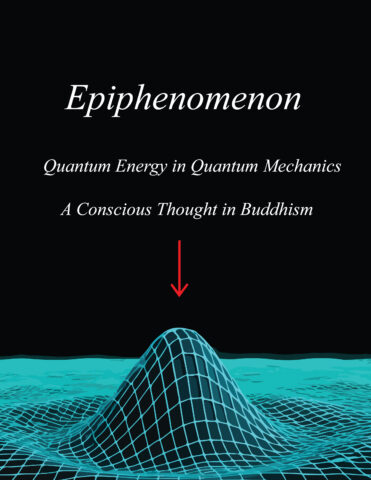
Before we move on, let us recall a concept that we discussed in earlier posts. As illustrated in the image above, in quantum mechanics, epiphenomena are ripples in the quantum energy field and therefore are quantum energy. On the other hand, in Buddhism, epiphenomena are ripples in a field of consciousness known as non-luminosity. Because they fluctuate in consciousness, epiphenomena in Buddhism are conscious thoughts.
As in Post 27, we will use the example of humans observing a galaxy to illustrate the observation process.
According to the Five Aggregates, human observation of the galaxy begins with the Aggregate of Receiving, when the eye consciousness perceives the “experiential contents” of the galaxy. This is followed by the Aggregate of Thinking, indicating an active mind, when the perceived “experiential contents” become the “reading in of the observer’s mind.” What carries the “experiential contents” from the galaxy to the observer is the waves of consciousness in which both the epiphenomenon of the galaxy and the observer exist.
Furthermore, as discussed in Post 27, once “experiential contents” become “reading of the mind,” they are met by “billions of thoughts per second.” The significance of meeting “billions of thoughts per second” is that the waves carrying the “experiential contents” become more turbulent. Greater turbulence causes larger ripples and, therefore, epiphenomena to form in non-luminosity.
The third step involves the Aggregate of Action, which refers to the fact that the epiphenomena in waves of consciousness are “conceptualized in ways we do not govern.” Furthermore, as discussed in Post 27, conceptualization means that “every thought takes a form, (Chinese: 念念成形) and “all forms are consciousness (Chinese: 形皆有識).”
The “form” in “Everything thought takes a form” refers to the fact that thoughts in non-luminosity large enough to be epiphenomena appear with an external appearance that scientists can “measure” and Buddha can perceive directly. On the other hand, thoughts that are not large enough to be epiphenomena become the “turbulence” that can neither be measured nor perceived directly.
The word Buddha uses to indicate the external appearance of a thought large enough for Buddha to perceive directly is “image.” For example, as discussed in Post 25, Buddha’s definition of direct perception is that it is “nonconceptual in the sense that it does not perceive its object through the medium of an image, as does thought.” In other words, to perceive mentality directly, one must prevent the formation of the “image”. Since the only way to prevent the “image” from forming is to avoid the conceptualization process, we can infer that the “image” refers to the conceptualized external appearance of thoughts large enough to be an epiphenomenon.
This is how the Observer Effect arises in humans. While epiphenomena and turbulence are both ripples in non-luminosity, their differing levels of observability make them appear distinct.
After the “forms” are conceptualized, the Aggregate Consciousness then projects the “form” from the observer’s mind. The projected “forms” then manifest as the Aggregate of Rupa. The Aggregate of Rupa refers to the universe of which humans are a part and is often considered “physical” by them. There is even a discipline known as “physics” that focuses on investigating the “physical” world.
However, there is nothing “physical” in the universe because it is manifested from “forms” conceptualized in the observer’s mind, “in ways he does not govern,” to use Dr. Fisch’s words, mentioned in Post 23, and projected from his consciousness.
As discussed in many earlier posts, any enlightened individual, such as Adyashanti, and two prominent monks from the Tang Dynasty in China. As discussed in Posts 10 and 11, respectively, Adyashanti and the two monks all witnessed the universe disappear upon their enlightenment, when their minds were quiescent. The reason is simple: when their minds are quiescent, projections of consciousness are impossible. Without projections of consciousness, the universe cannot be manifested anymore.
The Buddha calls any consideration of “physical” entities in the universe a delusional misunderstanding of reality, the result of “the reification of what are actually imaginary external phenomena.” However, humanity is not to be blamed. As discussed in Post 15 on the Three Delicate Marks, born with consciousness, unenlightenment is innate to humans; likewise, “the reification of what are actually imaginary external phenomena.”
However, delusion does not start with human beings. As also discussed in Post 15, the Buddha teaches that the Observer Effect first occurs in the smallest epiphenomena in the universe known as the “neighbor-to-emptiness dust “(Chinese: 鄰虛塵). In the Three Delicate Marks, Buddha teaches that “neighbor-to-emptiness dust” can be either the Observer or the Observed. However, he calls the Observed “neighbor-to-emptiness dust” a delusional eternal realm, clearly indicating that he deems treating the Observer and the Observed as different a delusional misunderstanding of reality.
The fact is that in a universe built by consciousness, everything is conscious. In such a universe, not only can the Observer Effect occur in the smallest epiphenomenon in the universe, but it can also happen with photons, electrons, and scientific sensing equipment and detection screens. They are all conscious epiphenomena in the field of consciousness known as non-luminosity. That they are the same cannot be changed by observation.
(If you like this post, please like it on our Facebook page and share. Thank you.)