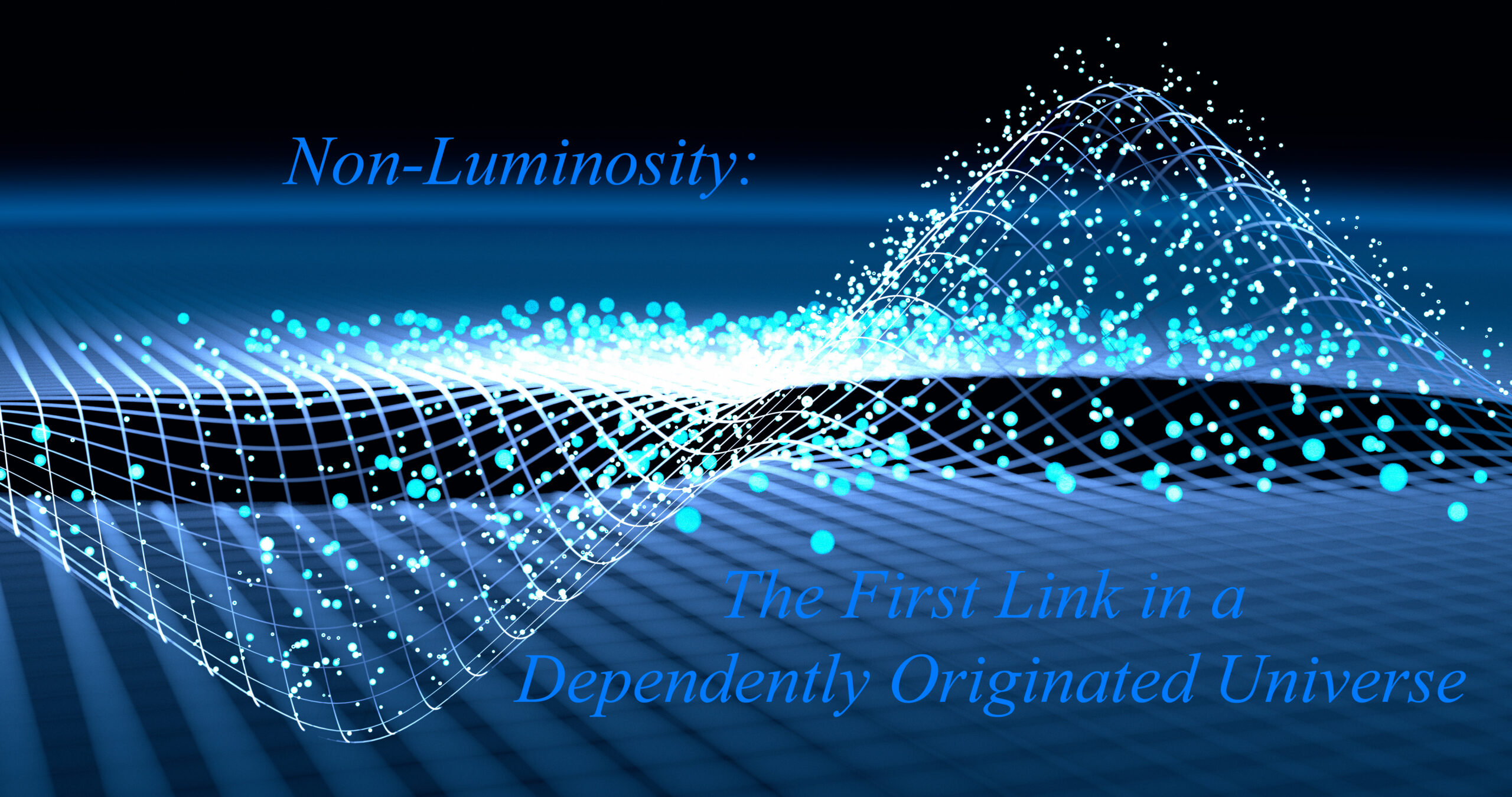

Having discussed non-luminosity as a conscious quantum field in the previous post, we now discuss non-luminosity as the first link in a Buddhist doctrine known as the Twelvefold Chain of Dependent Origination.
In science, there are eight theories on the origin of the universe. While the Big Bang theory is the favorite among scientists, the Quantum Fluctuation Theory would probably receive Buddha’s stamp of approval as the closest to nature. Also known as quantum field theory, it is considered by some to be the Most Beautiful Theory in Physics. Furthermore, quantum physicists, such as David Tong, “a British theoretical physicist,” and “a professor at the University of Cambridge,” consider the quantum field to be the building block of the universe.
In Buddhism, non-luminosity is equivalent to the quantum field in quantum mechanics because, as the first link in the Buddhist doctrine known as the Twelvefold Chain of Dependent Origination, it can be considered the foundation block of the universe humans experience, which Buddha deems dependently originated.
Twelvefold Chain of Dependent Origination (Romanized Sanskrit: pratityasamutpada; Chinese: 十二緣起), according to The Princeton Dictionary of Buddhism, is “in Sanskrit, ‘dependent origination,’ ‘conditioned origination,’ lit., ‘origination by dependence’ (of one thing on another); one of the core teachings in the Buddhist doctrinal system.” Additionally, “In one of the earliest summaries of the Buddha’s teaching, Buddha is said to have taught: “When this is present, that comes to be. /From the arising of this, that arises. /When this is absent, that does not come to be. /From the cessation of this, that ceases.”
In the doctrine, Buddha enumerates twelve interconnected links, with each link serving as the cause (Romanized Sanskrit: nidana, Chinese: 因緣/尼陀那) for the origination of the following link until the lifecycle ends in “aging and death (Romanized Sanskrit: jaramarana; Chinese: 老死).” It is a cycle that all phenomena in the universe, or dharma, must undergo, including the universe itself.
However, for a phenomenon that is dependently originated, having a proper cause to start is insufficient because the right conditions must also be present simultaneously for the cause to bear fruit.
Condition (Romanized Sanskrit: pratyaya; Chinese: 緣), according to The Princeton Dictionary of Buddhism, refers “to the subsidiary factors whose concomitance results in the production of an effect from a cause.” “For example, in the production of a sprout from a seed, the seed would be the cause (Hetu), while such factors as heat and moisture would be conditions (pratyaya).” This is why “dependent origination” is also called “conditioned origination.”
The significance of being the first link in the Twelvefold Chain is that it itself cannot be conditionally originated, or it would create a chicken-and-egg dilemma. For example, some Buddhists believe human ignorance is the first link in the Twelvefold Chain of Dependent Origination. However, given that history never recorded a time when humans suddenly became ignorant, it is necessary to ask, “Where does human ignorance come from?” This is as necessary to ask this question as Purna needed to ask Buddha the question, “Where does non-luminosity without a beginning come from (Chinese: 無始無明是怎麼來的?).
As discussed in the previous post, in the Śrīmālādevī Siṃhanāda Sūtra (Chinese: 勝鬘師子吼一乘大方便方廣經, English: Lion’s Roar of Queen Śrīmālā), Buddha teaches that non-luminosity is “non-luminosity without beginning (Chinese: 無始無明).” However, Purna (Chinese: 富樓那), a disciple of Buddha and the “foremost in expounding the Dharma,” did not understand the meaning of “non-luminosity without beginning.” So, in the Śūraṅgama Sūtra (Chinese: 大佛頂首楞嚴經), he asked Buddha, “Where does non-luminosity without a beginning come from (Chinese: 無始無明是怎麼來的)?” The logic of his question was precisely what was mentioned earlier: if non-luminosity is the foundation block of a universe that is dependently originated, then where does non-luminosity come from?
Buddha responded to Purna by saying, “It does not have a reason. It comes from nowhere, and it goes to nowhere (Chinese: 它沒有來處, 也沒有去處),” meaning that non-luminosity does not have a beginning, nor does it have an end. In other words, its existence is eternal.
This is compatible with what Buddha teaches in Such is the Way of Dharma, where he teaches that both Citta and Rupa are “noncausal (Chinese: 非因緣),” meaning that their existence is without cause, i.e., natural and eternal.
As discussed in Post 4, in Mohe Zhiguan (Chinese: 摩訶止觀), Buddha teaches that “mentality gives rise to Rupa (Chinese: 色從心生).” The mentality that gives rise to Rupa, as Buddha referred to in Mohe Zhiguan, is the fluctuating mentality of non-luminosity.
As discussed in the previous post, as the only field of fluctuating mentality everywhere and for all times, non-luminosity can potentially serve as the foundational block of a multiverse when the right local conditions also exist simultaneously.
The origin of the universe is no exception. It could have originated approximately 13.8 billion years ago only if the conditions were right at the time.
Buddha, however, never discusses what conditions caused what. On the other hand, science provides various theories. One theory suggests that the universe arose when the densities of matter and space were roughly equal. The universe exists now because those conditions existed more than 13 billion years ago, and it still exists because the same conditions persist today. When the right conditions no longer exist, the universe will disappear as well. This is why the universe and everything in it are considered conditioned and impermanent phenomena in Buddhism.
(If you like this post, please like it on our Facebook page and share. Thank you.)